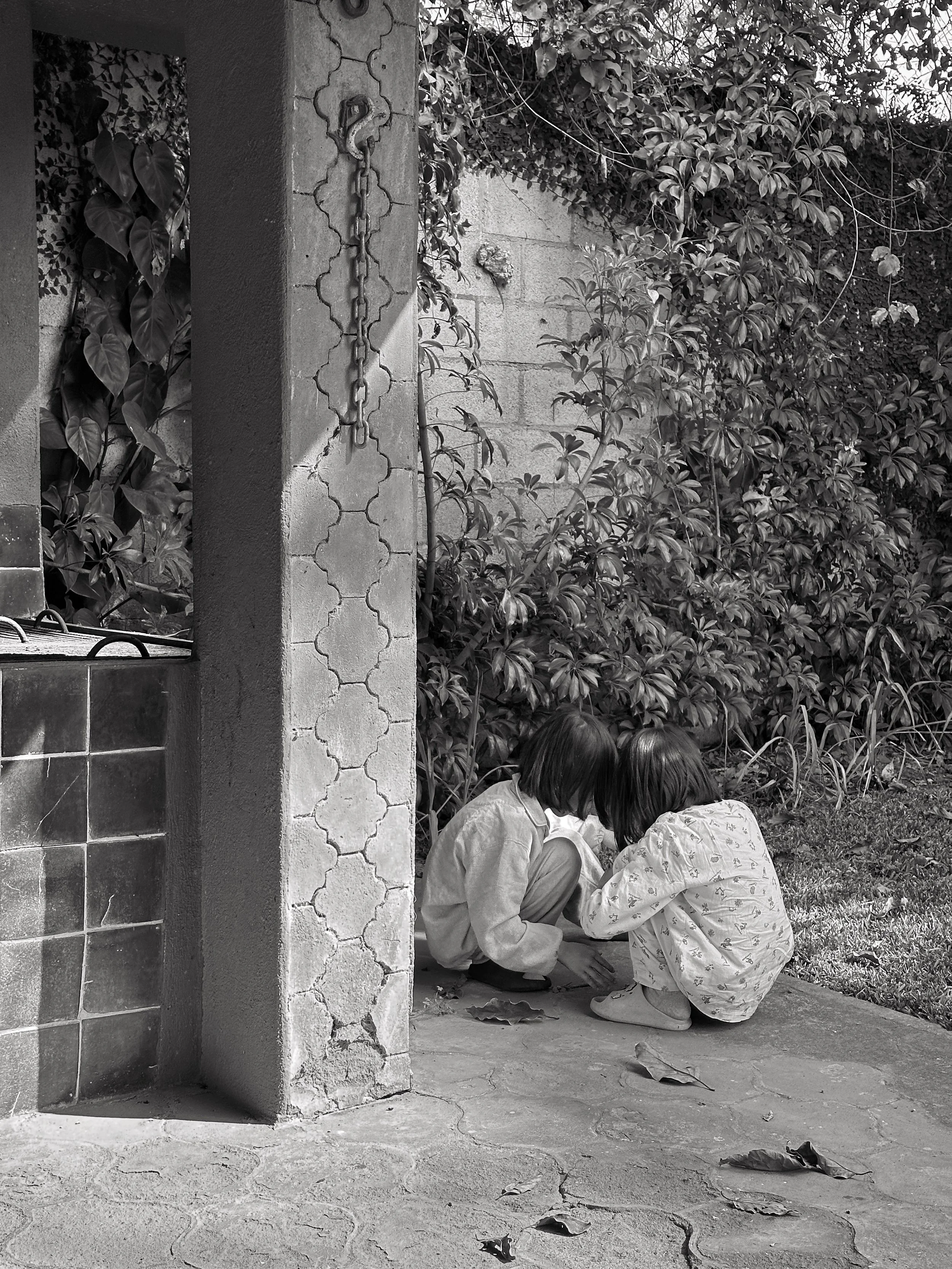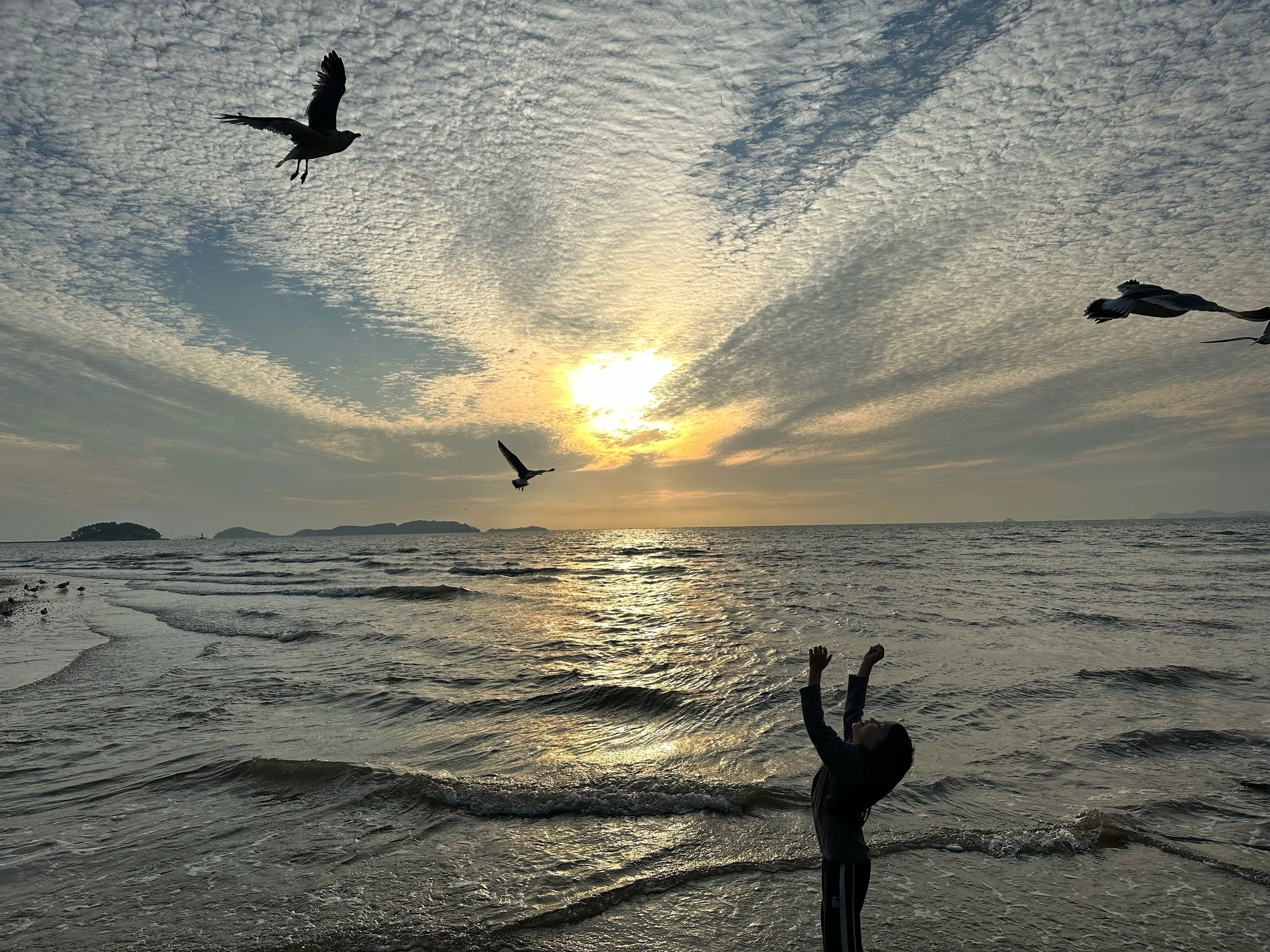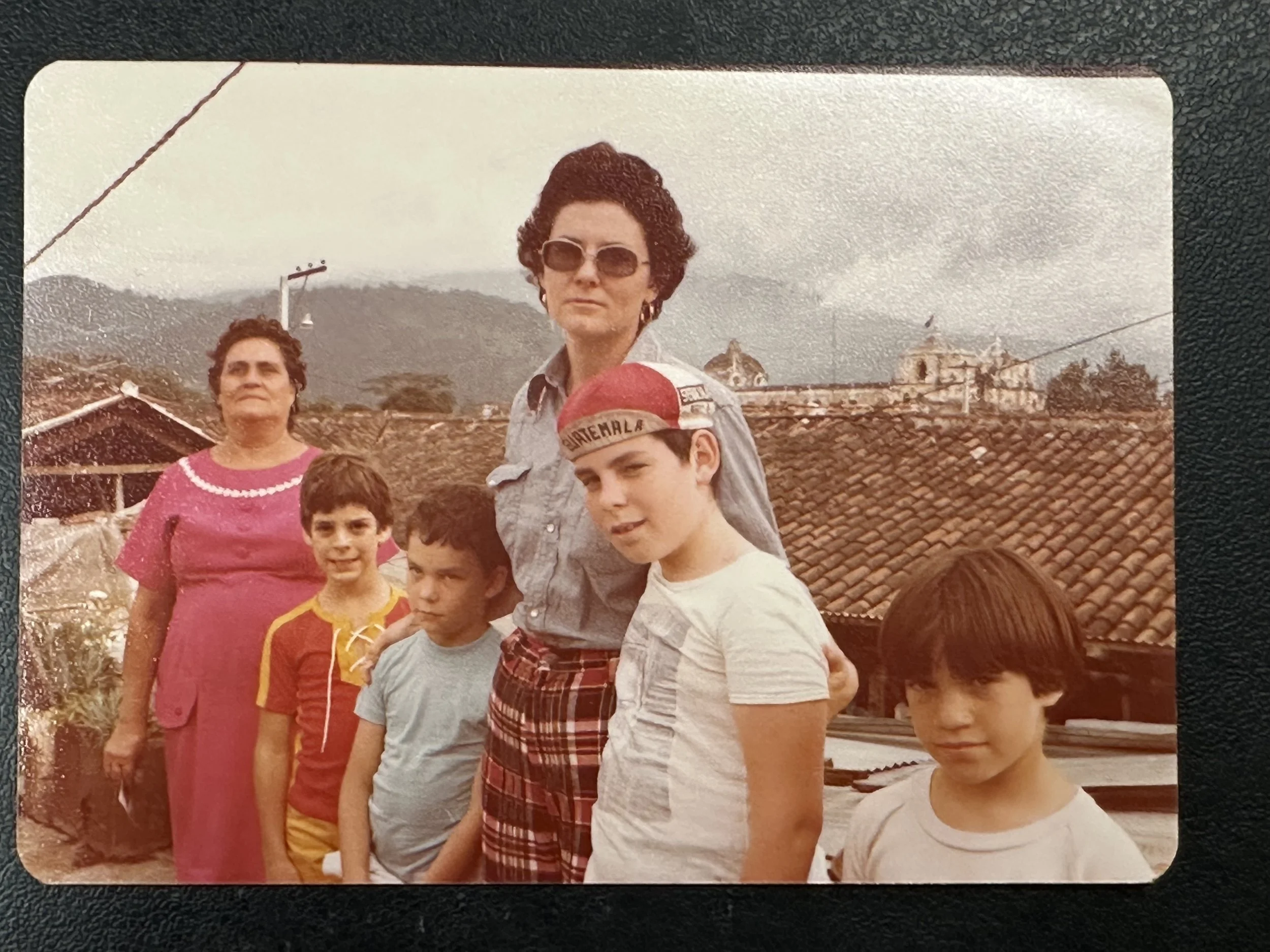
Una foto entre tantas otras. Un día entre otros tantos. Un momento ordinario como cualquiera de los que vivimos a diario. Pero contigo.
Que no daría por abrazarte hoy y celebrar juntos tu cumpleaños.
© Jaime Permuth, 2026
Una foto entre tantas otras. Un día entre otros tantos. Un momento ordinario como cualquiera de los que vivimos a diario. Pero contigo.
Que no daría por abrazarte hoy y celebrar juntos tu cumpleaños.
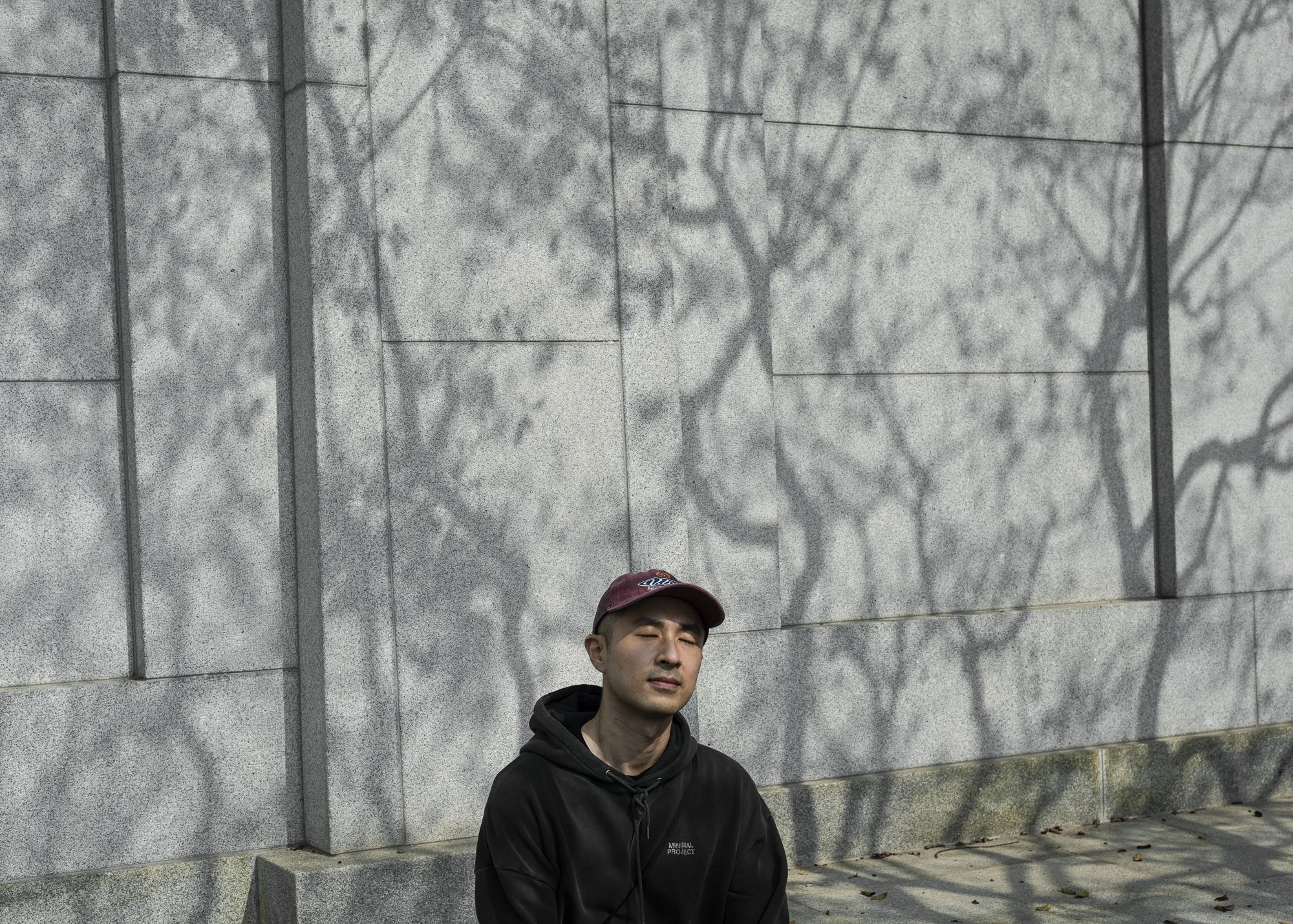
It is Sunday morning. Local families are coming in to attend mass. An old man dressed in grey trousers, white button down shirt and a black jacket with ornamental embroidered lapels is flanked by two younger women. As they are about to enter, I greet them and ask for the name of the town. “San Miguel Escobar”, he says. “Where are you visiting from? You speak very good Spanish for an American”. “Actually, like yourself, I’m Guatemalan. But my family and I are visiting from Korea.” “Korea! Our priest is Korean. He speaks with a funny accent you know, even though he’s been here for many years”.
***
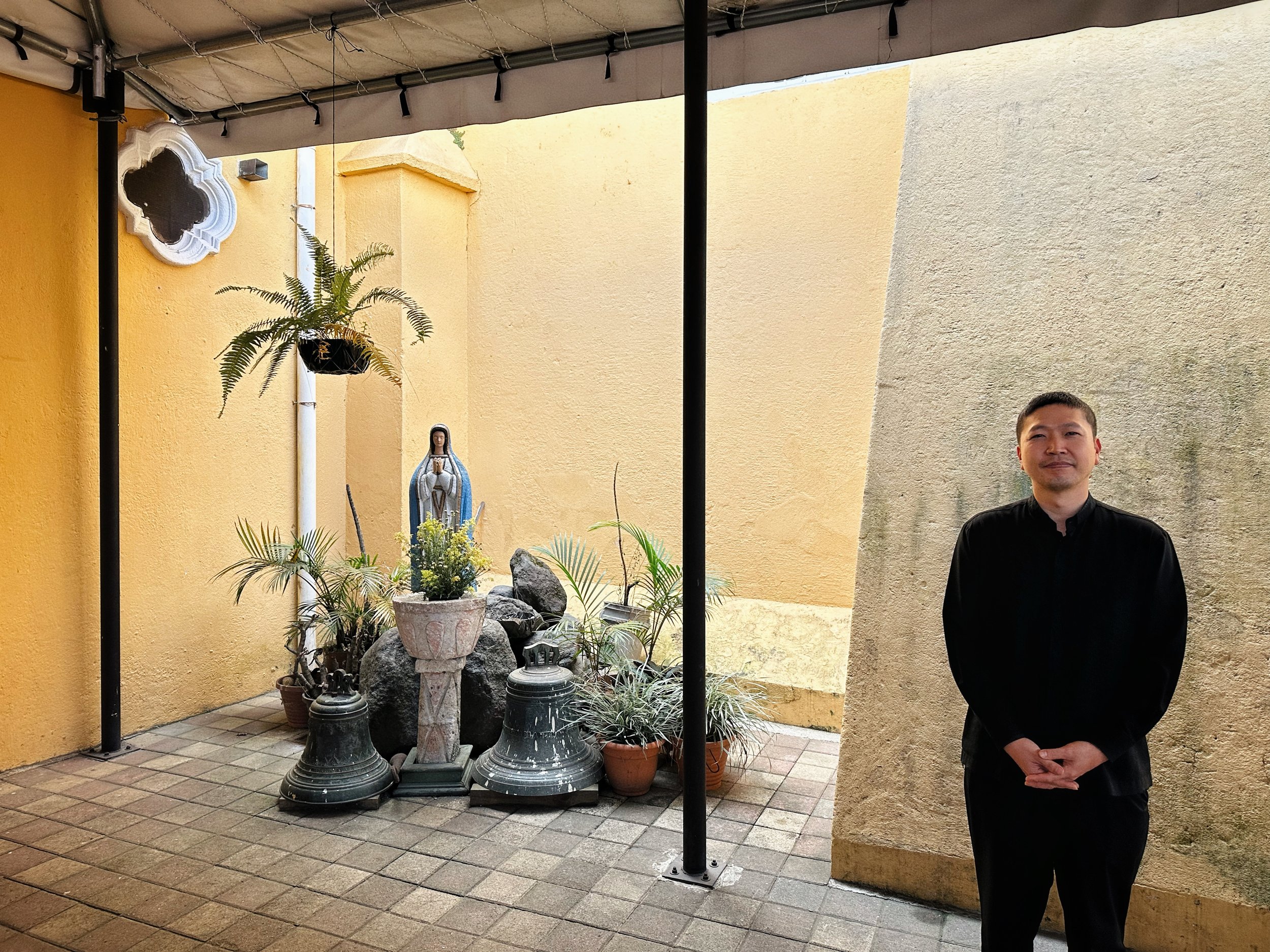
I return to the Church a few days later. It happens to be Ash Wednesday. Mass is about to start. Padre “Pablito” Kim walks out to the pulpit in a floor-length flowing white robe. His words are Spanish but his intonation and rhythm Korean. Padre Kim is a tall man in his early 40s, slim with close-cropped hair.
I walk back to the Administrative Office and talk to the secretary on duty. I learn that Padre Kim is the third successive Korean priest of the Parroquia San Miguel Escobar.
Overwhelmed by curiosity, the following morning I am back at the Church to meet Padre Kim. I wait for fifteen minutes and then he joins me in the Office. The previous day he had officiated mass six separate times and his face looks creased and drained of color. I offer to buy him a cup of coffee. Politely and firmly he declines, adding he has a busy morning.
Nevertheless, we begin talking, alternating between Korean and Spanish. An hour later we are still standing in the same spot. I ask if I can make a quick portrait of him. After I do, we sit together on a bench and talk some more.
His reticence and reserved tone are gone now. And we sit side by side, like old friends.
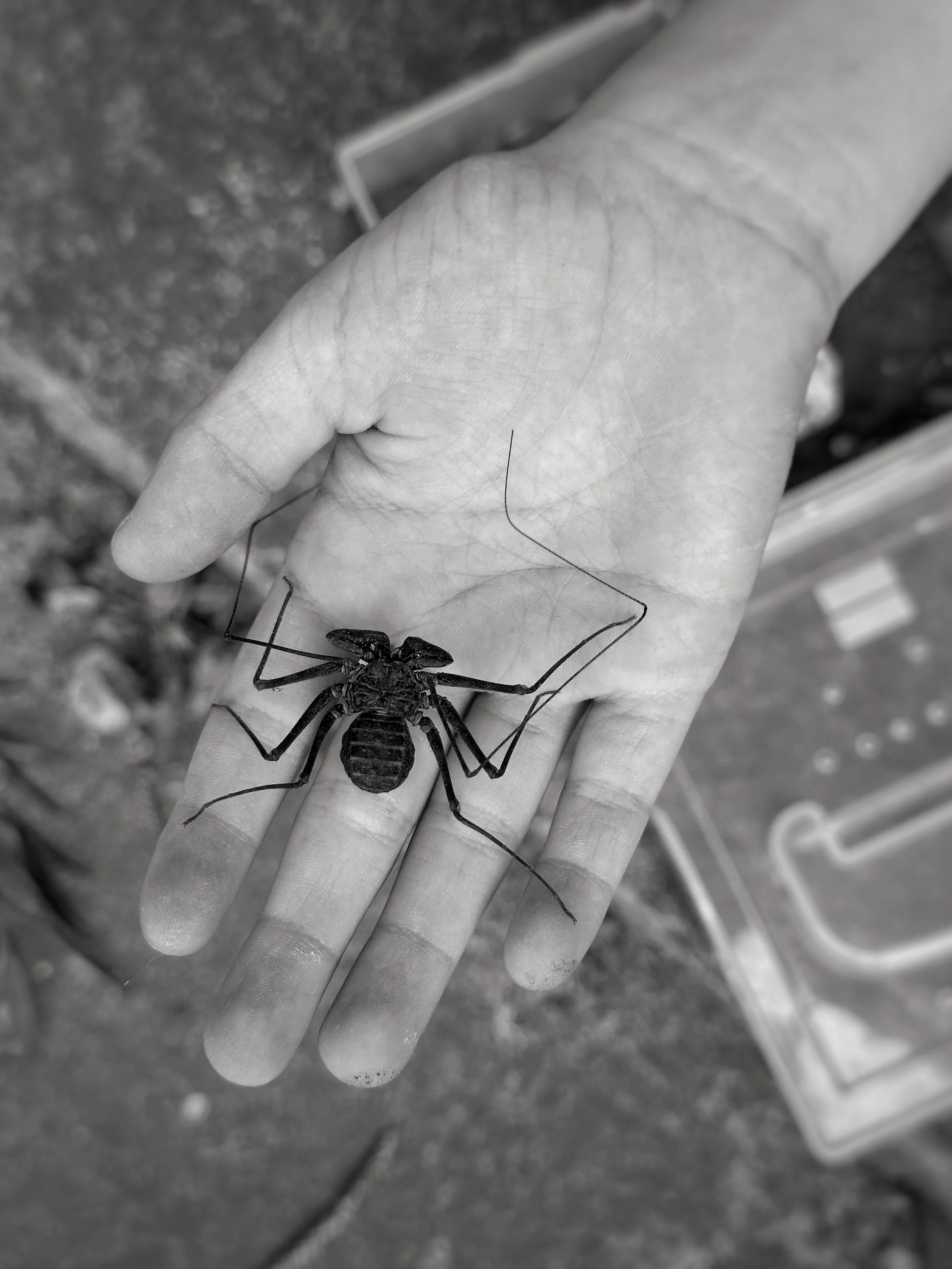
I am about to shower when Hye-Ryoung runs into the house, breathless, and tells me the boys found a scorpion in the garden.
We dash out to take a closer look and make sure the kids keep their distance.
However, Olin and Luca know that whip scorpions - such as the one they found - are tailless and not venomous. Although they are able to spray an irritant mist when cornered, they tell us there is no reason to be afraid.
Still, as I come closer, they both yell at me to stop, afraid that I will kill the scorpion instead of letting them trap it in a cage.
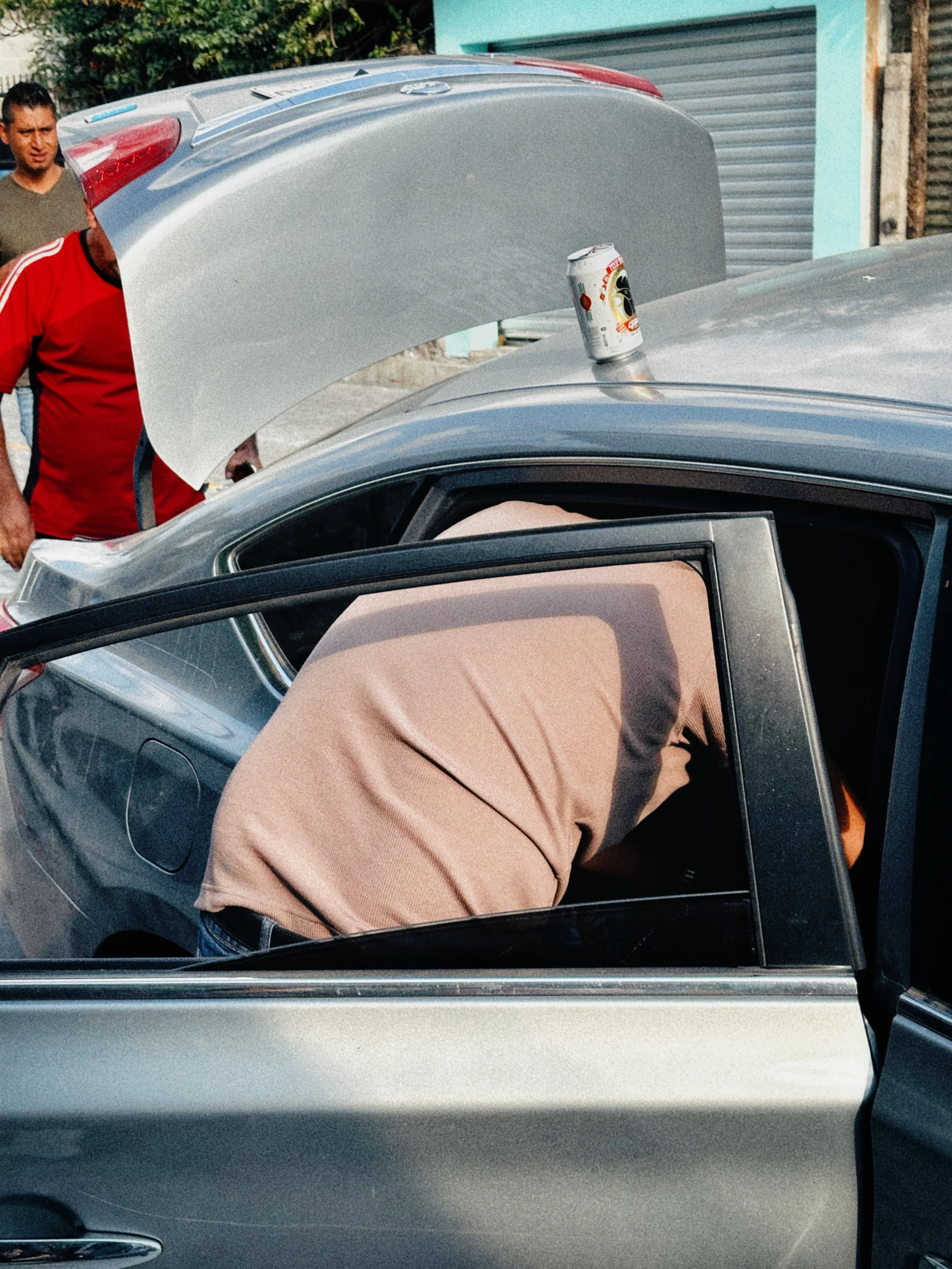
Guatemala es… bajarse del taxi con una Gallo a medio camino. Feliz Día del Cariño y… salucita pués 🍻
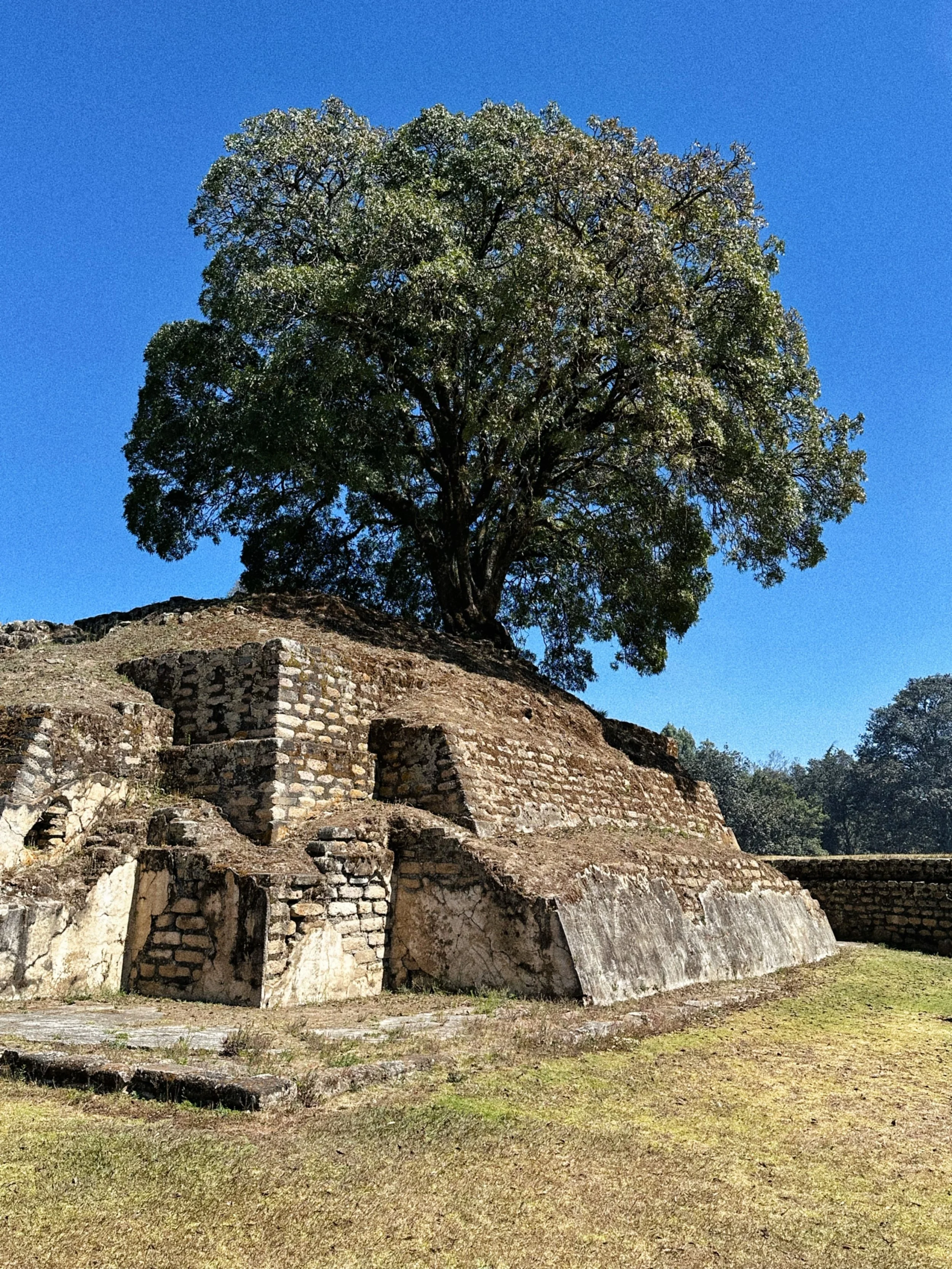
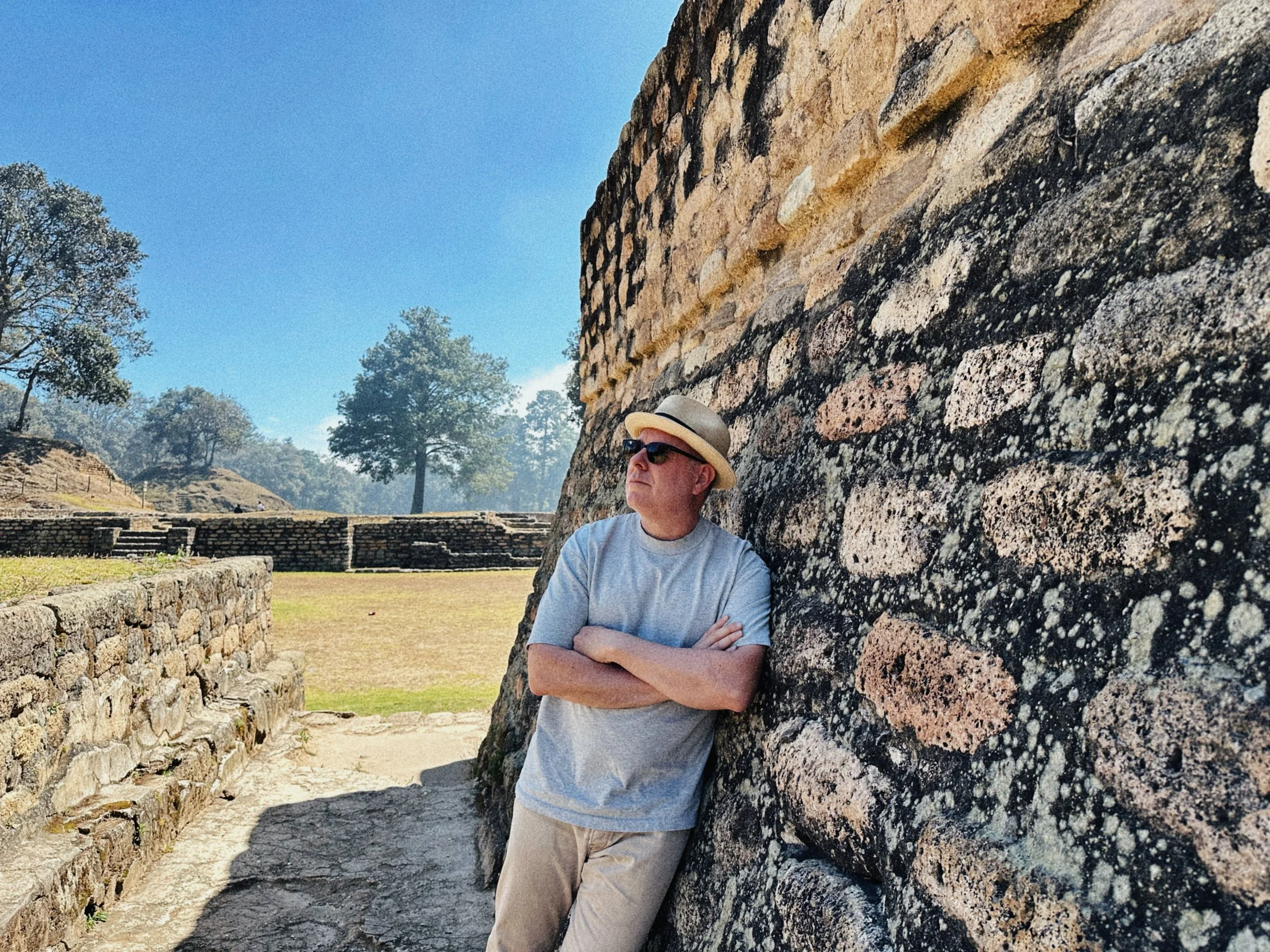
Iximché, ancient capital city of the Kaqchikel people is not only a splendid archeological site. It is also a living, sacred space which continues to serve as a site for pilgrimage and ritual.
During our visit today I approached a woman dressed in a beautiful huipil and asked her if she could recount for Luca and Olin the Popol Vuh story of Hunahpú and Ixbalanqué the heroic twins who descend to the netherworld to avenge their father and defeat the Lords of Xibalbá. Thereafter the twins ascend to the sky, becoming the Sun (Hunahpú) and the Moon (Ixbalanqué).
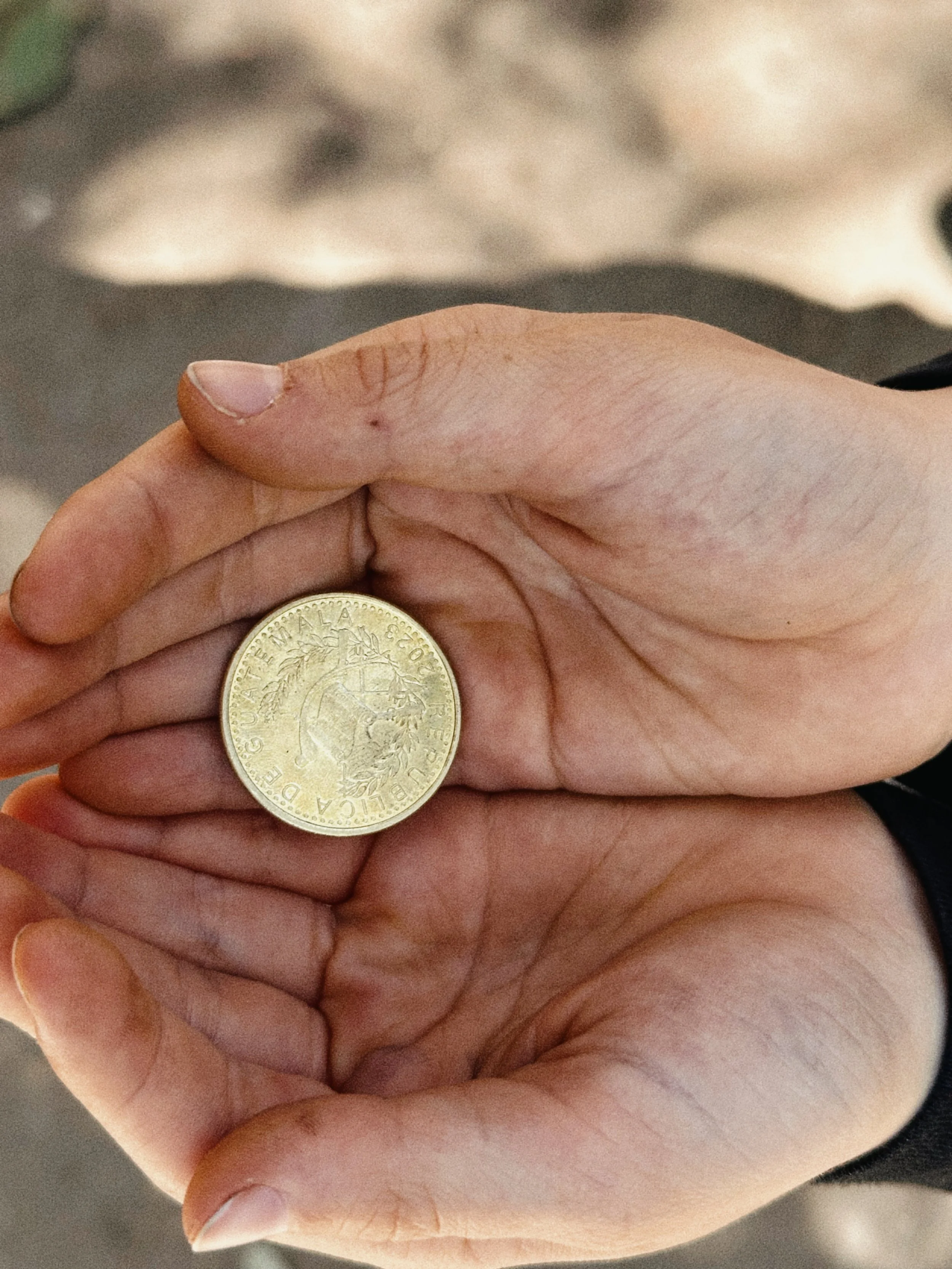
When she was done recounting the tale she reached into her bag and brought out two shiny coins. She explained to me that twins should always be honored, preferably with an offering of fruit or food but failing that with money. She also confided quietly to me that twins have the power to command ants and other insects and it’s always best to stay in their good graces.
With me, it’s always been a point of pride to keep current with literary trends, those writers and works of fiction and poetry that set the world ablaze.
However, to re-read volumes from my collection of books is strangely comforting: it reminds me of who I was before I immigrated to a country where my sense of identity became stranded in a morass of - to me - unreadable texts.
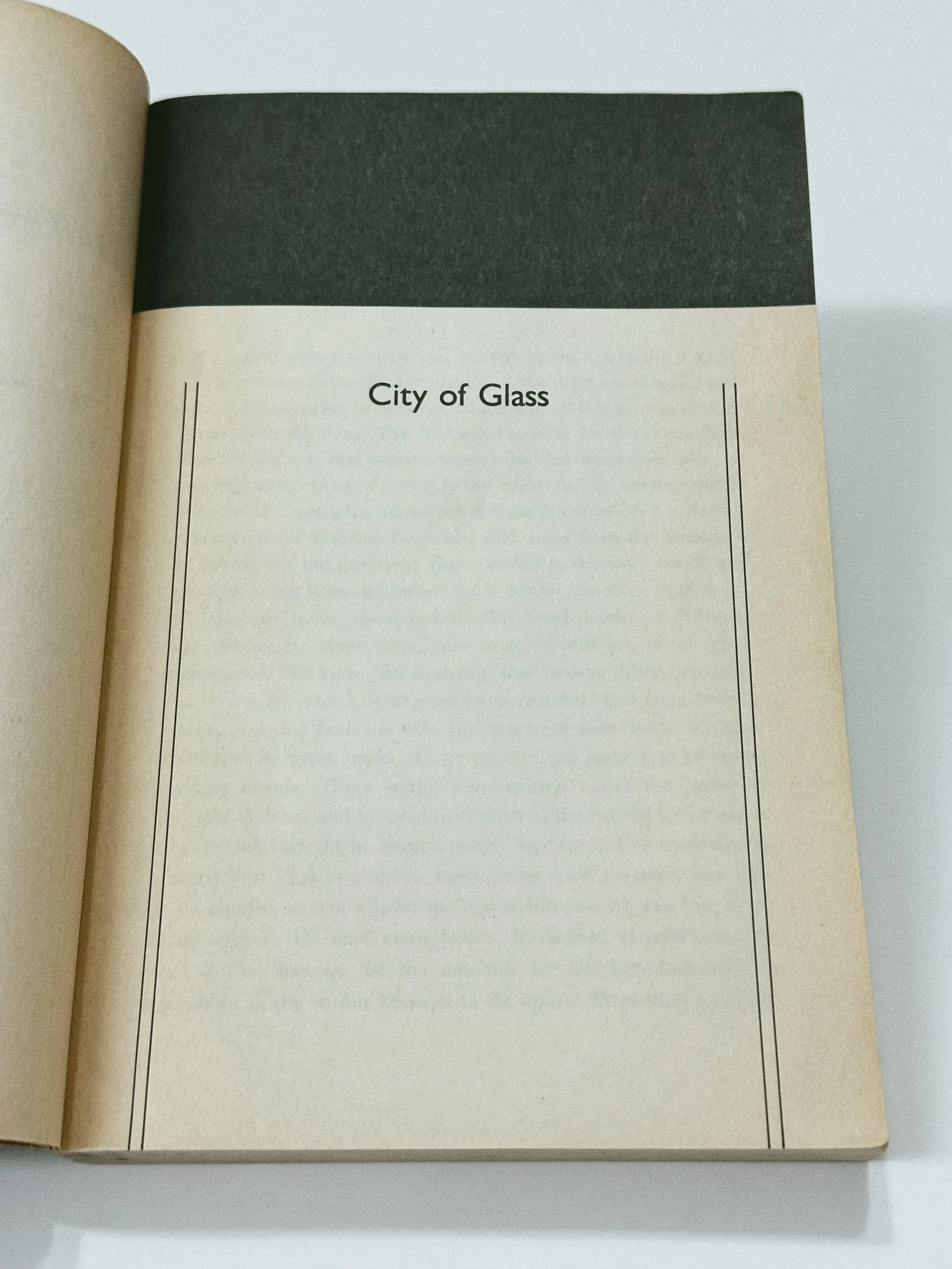
City of Glass, the first installment of Auster’s New York Trilogy, is narrated by Quinn, who writes detective stories under the pen name William Wilson.
Late one night, the telephone rings in his apartment and a stranger’s voice asks for Paul Auster. Calls repeat for several nights. The stranger insists on speaking to Auster and finally Quinn’s curiosity is piqued and he decides to impersonate him. Thus he embarks on a quest more mysterious than any William Wilson ever crafted for his audience.
I bought my copy of Auster’s trilogy secondhand during my grad school years, when I was down and out in New York, sharing a small apartment on Avenue A with three other roommates.
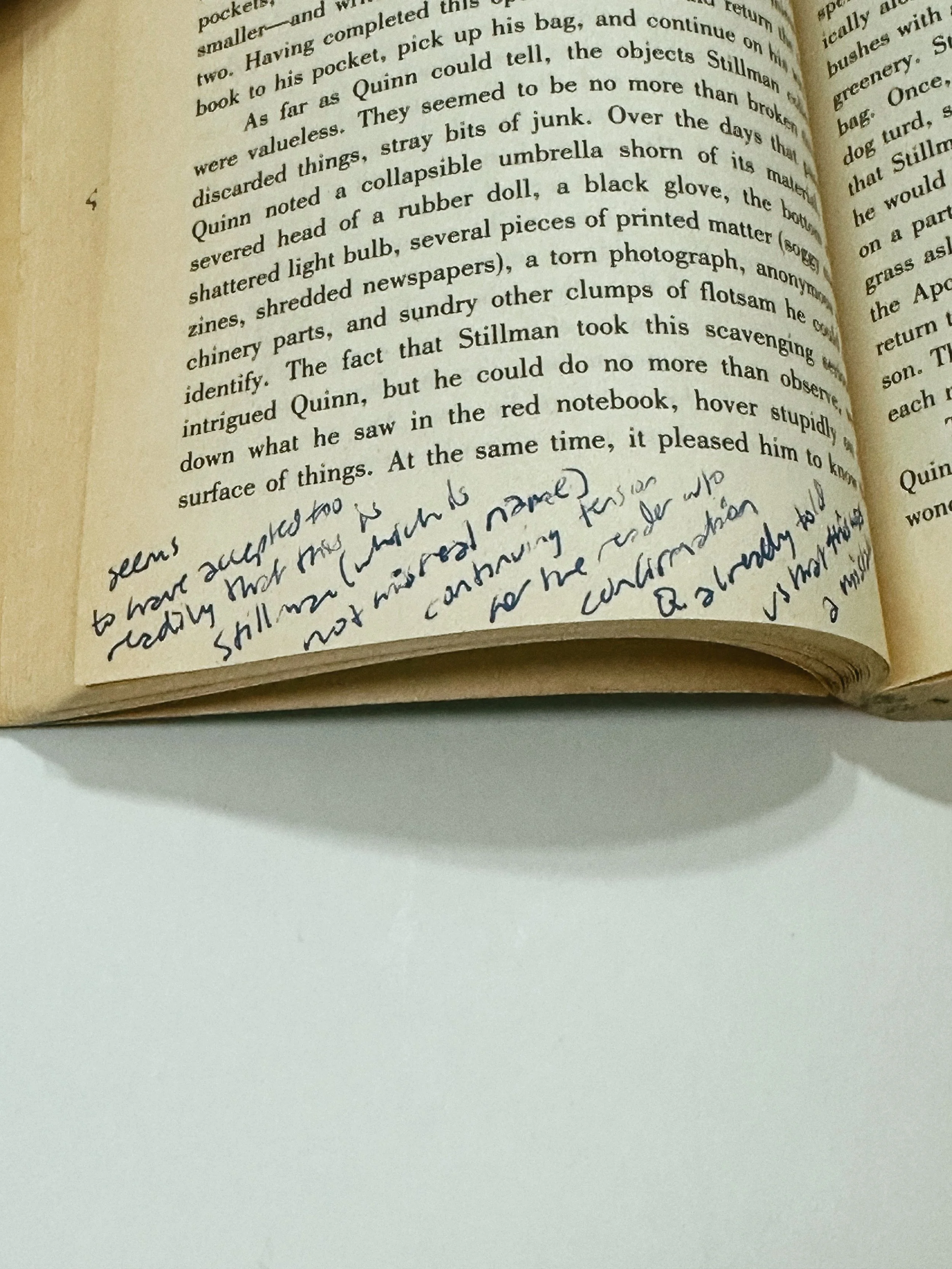
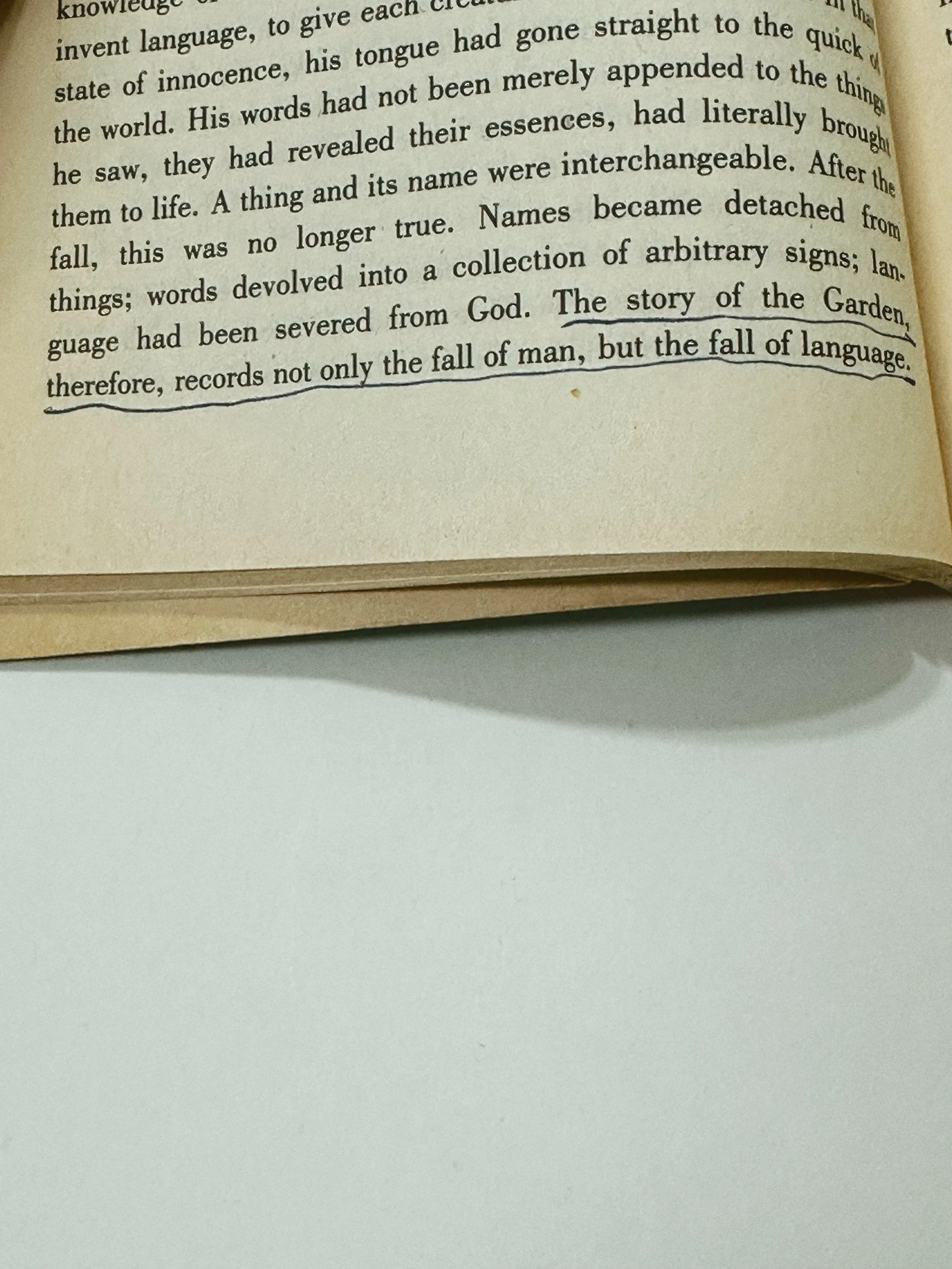
I remember standing in the bookstore, holding the book in my hands, frowning as I flipped through the pages and seeing there was some underlining of passages in blue ink and sometimes notes on the margins, which is something I never allow myself to do out of respect for my books.
However, I have to admit that this particular reader was so subtle and astute in her observations that her dialogue with the text feels almost like a fourth voice, dreamt up by Auster to create yet another mirror to disorient the reader in his maze of voices and images.
The sun rises, the sun sets. A day goes by and then another. As parents, we mark the time by their smiles. And sometimes, by their tears as well.
Today, I spent hours on the road driving. My thoughts circled back to this, our first year living in Seojong, and the many experiences we’ve had in this new chapter.
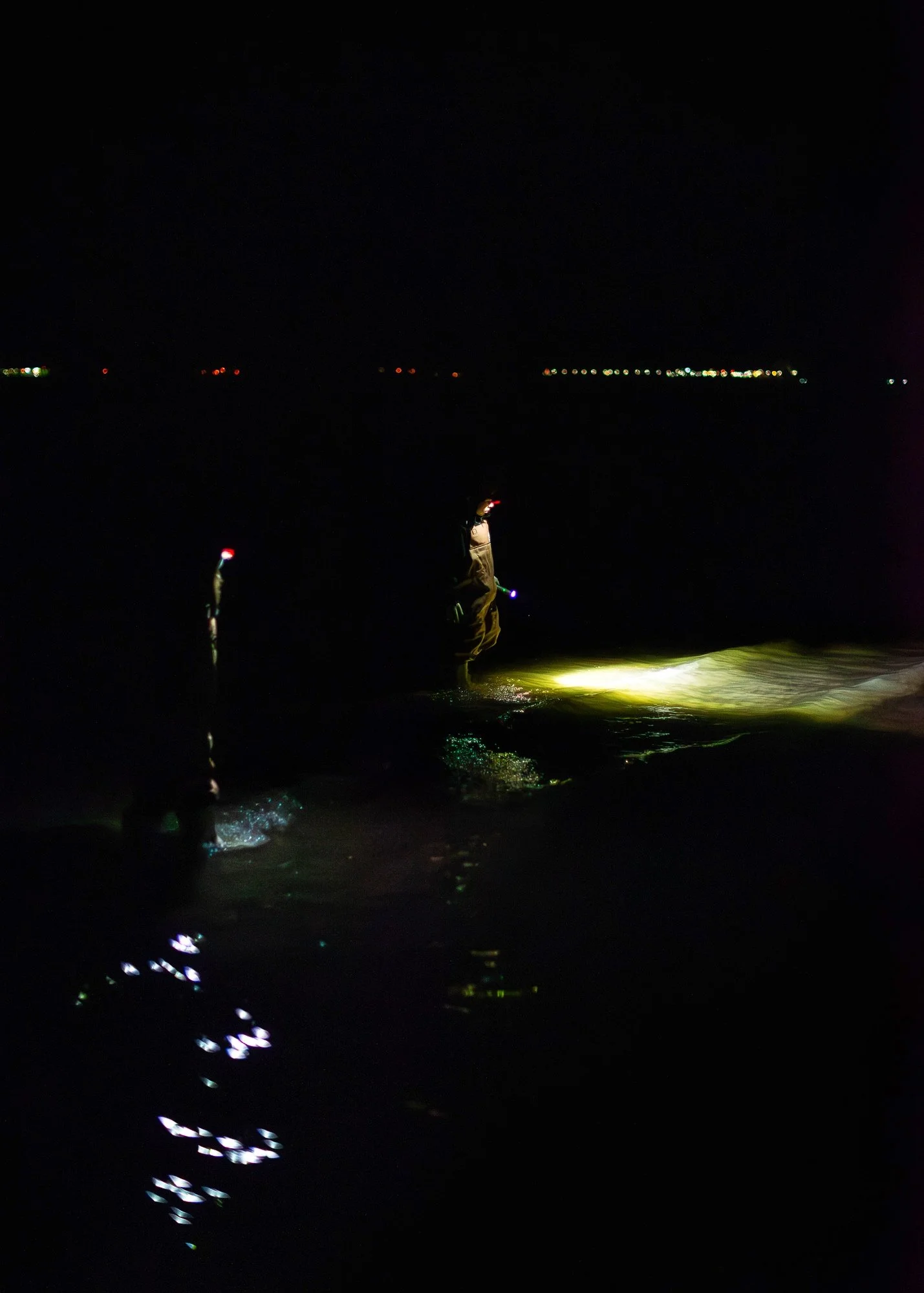
But also, the memory of our autumn trip to Taean was particularly vivid and present. Especially the night we waited till 10PM for the waterline to recede at low tide so we could venture out for crab hunting - all in pitch darkness.
***
Later this afternoon, when I was done with work, I went to pick up the kids; they surprised me by suddenly saying they would like to return to Taean this winter.
I hope they will treasure such memories all their lives. Because as the years go by, that’s ultimately what we hold onto: the love, the connection, the experiences we shared with each other.
***
To everyone who is reading these words, I wish you the very best in 2026.
Last time I had seen David Choi we were standing on a street corner in Harlem, a few years after he graduated the Photography program at New York Film Academy where I was his instructor.
I remember liking David right away when we first met. He was equal parts interested in writing and image making. David had a direct, unapologetic way of speaking. He was also savvy and street smart, with an edge about him. I knew all of these traits would serve him well in NYC. As that first semester drew to a close, I began to see other qualities in him as well: thoughtfulness, generosity and a fierce loyalty to his friends.
Time continued to move forward and somehow we managed to stay in touch as David assisted photographers in all the world’s fashion capitals: New York, London, Paris and then shot compelling editorial portraits in his own right.
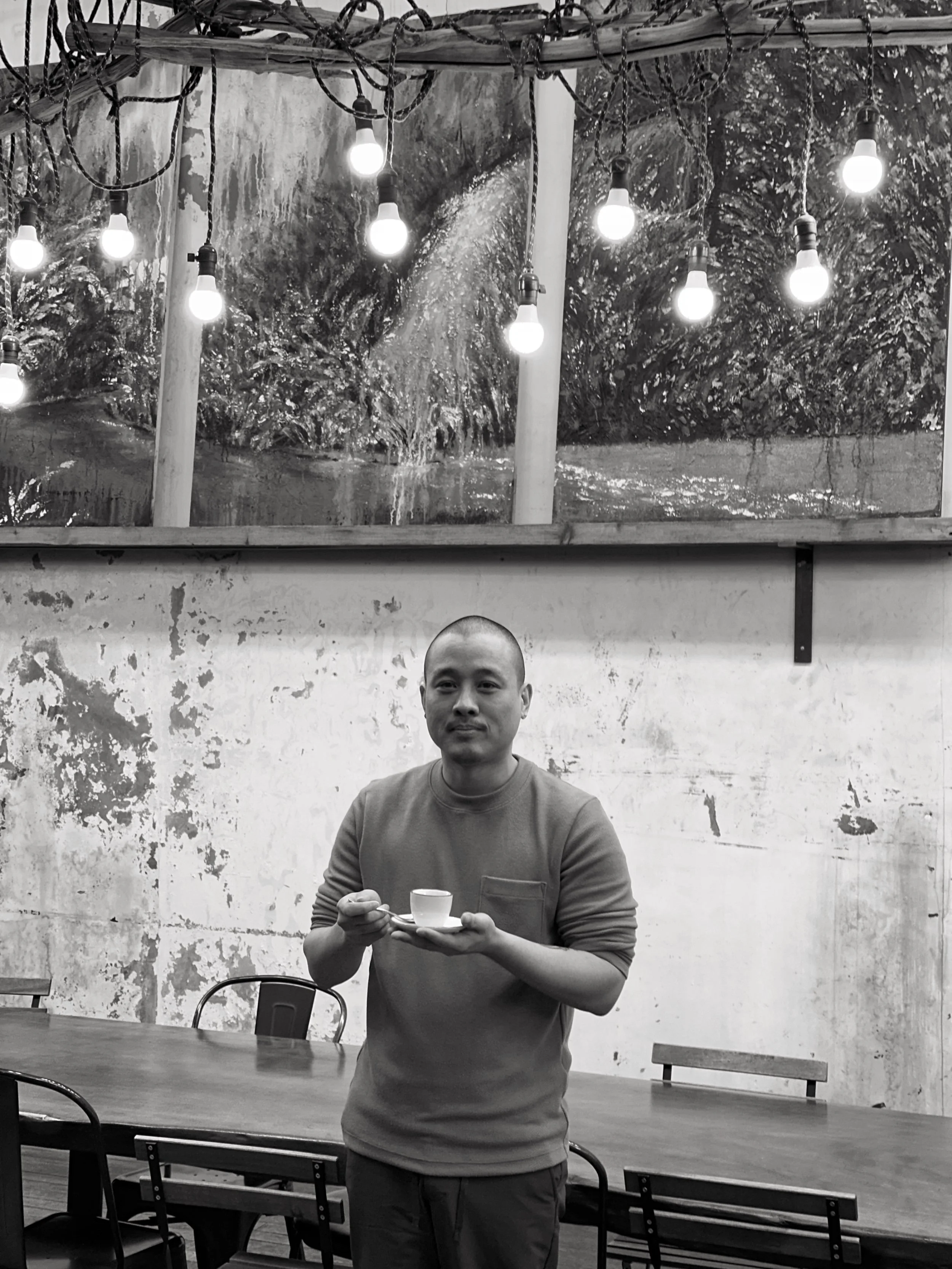
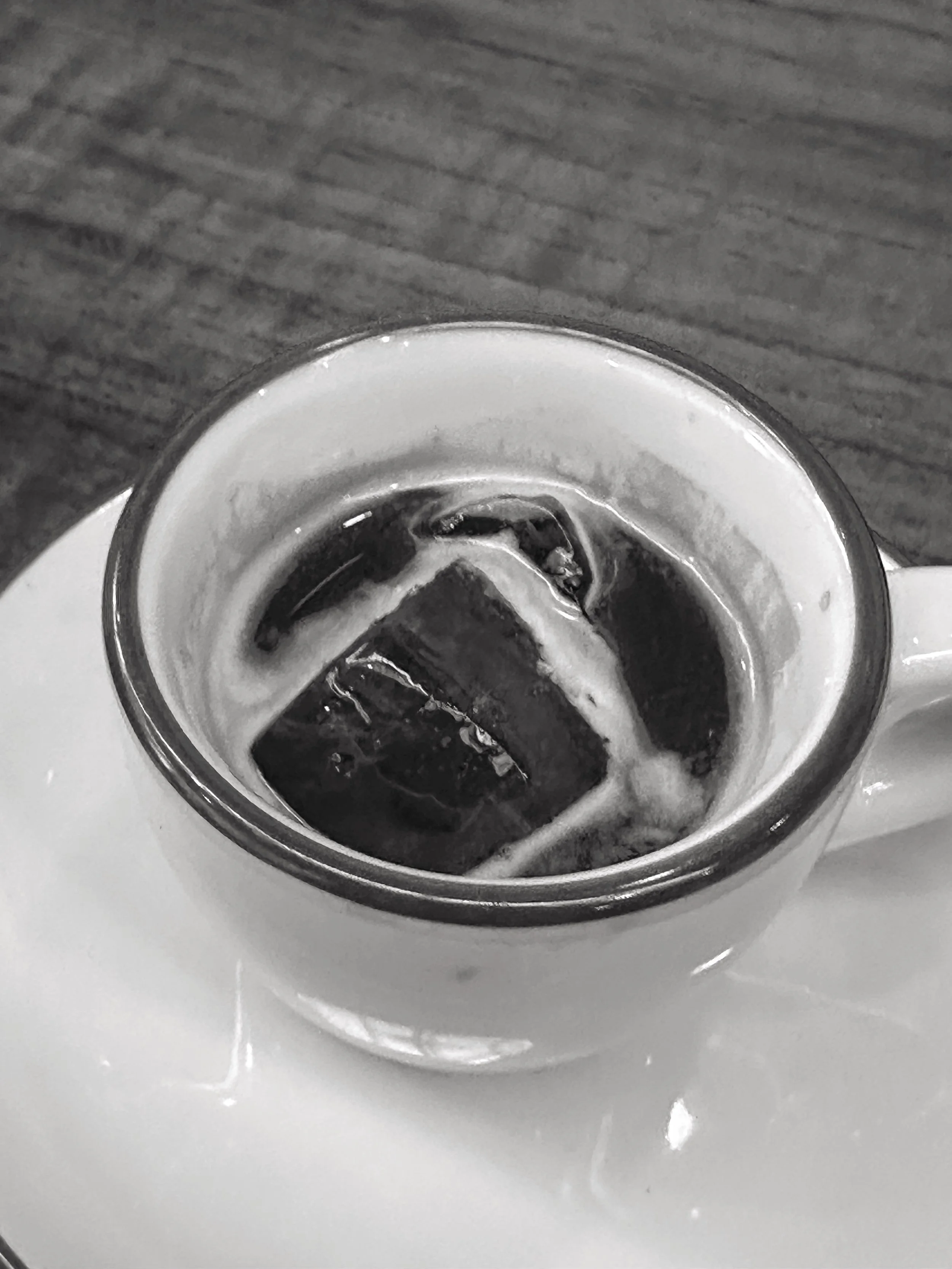
Fast forward to this week and a happy reunion in Seoul. We sat down to coffee, I blinked and when I looked up again, three hours had gone by and I had to hustle back home to pick up the kids from school.
These days, David is based in Toronto where he opened “Youthful Vengeance” a café/gallery which became a hub for artists and creatives and now functions as a non-profit with a mission to empower emerging artists.
When I hear the stories of former students like David, they make me feel grateful I spent fifteen years of my life as an educator.
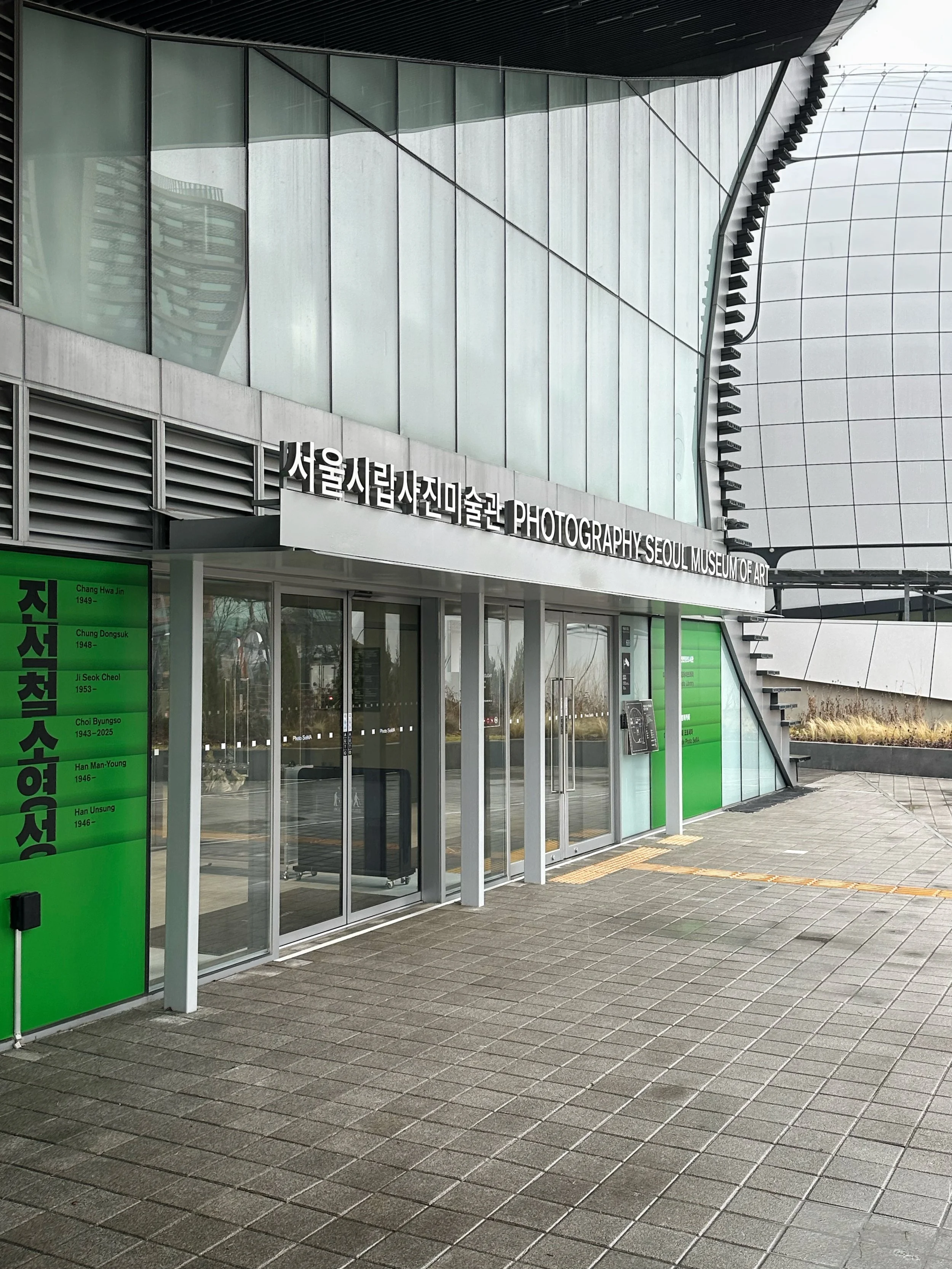
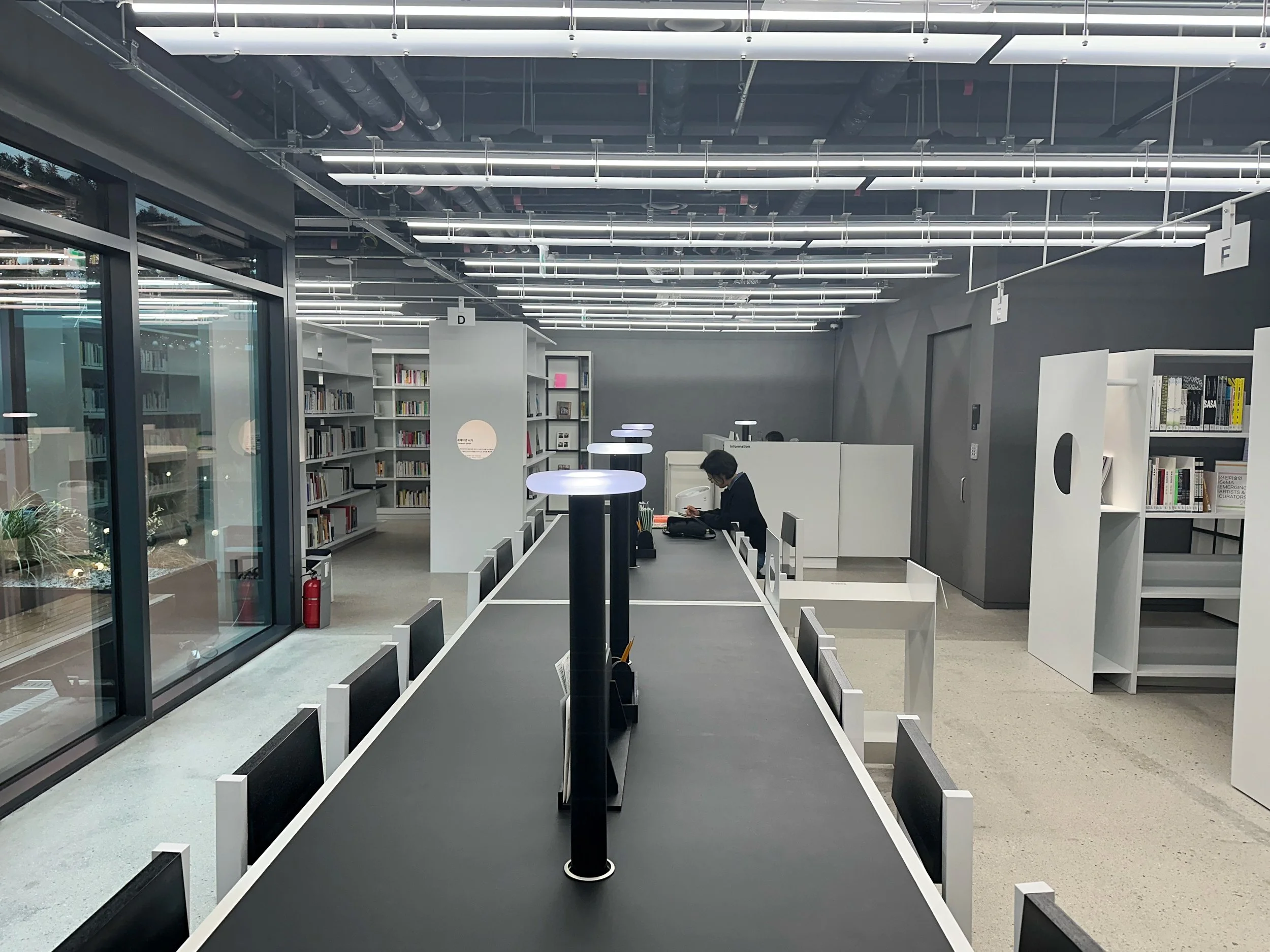
Our Gwanghapdan art collective is celebrating an important acquisition this week! Photography Seoul Museum of Art has an impressive and beautifully curated research library which will now hold a complete set of all the Zines and Playlists we have published to date. Additionally, the museum also acquired a robust selection of Gwanghapdan member catalogs and monographs.
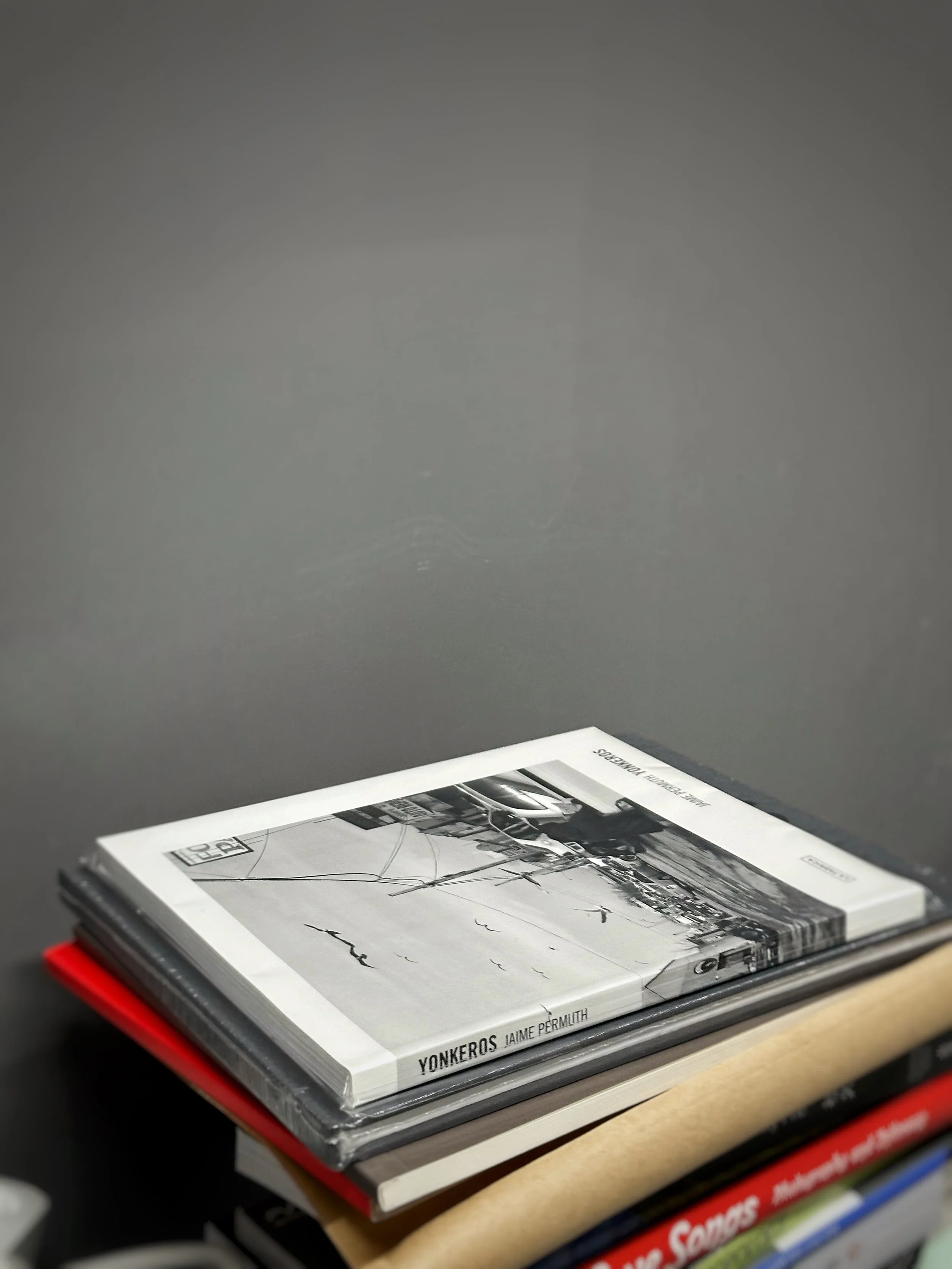
In my case, that includes my monographs YONKEROS (La Fabrica Editorial, Madrid , 2013) and The Street Becomes (Meteoro Editions, Amsterdam, 2021). Additionally, two books co-authored with my father Mario Permuth and my younger brother Igal Permuth: Re-trato de familia (MK Ediciones, Guatemala, 2004) and Tarzan Lopez (MK Ediciones, Guatemala, 2007).
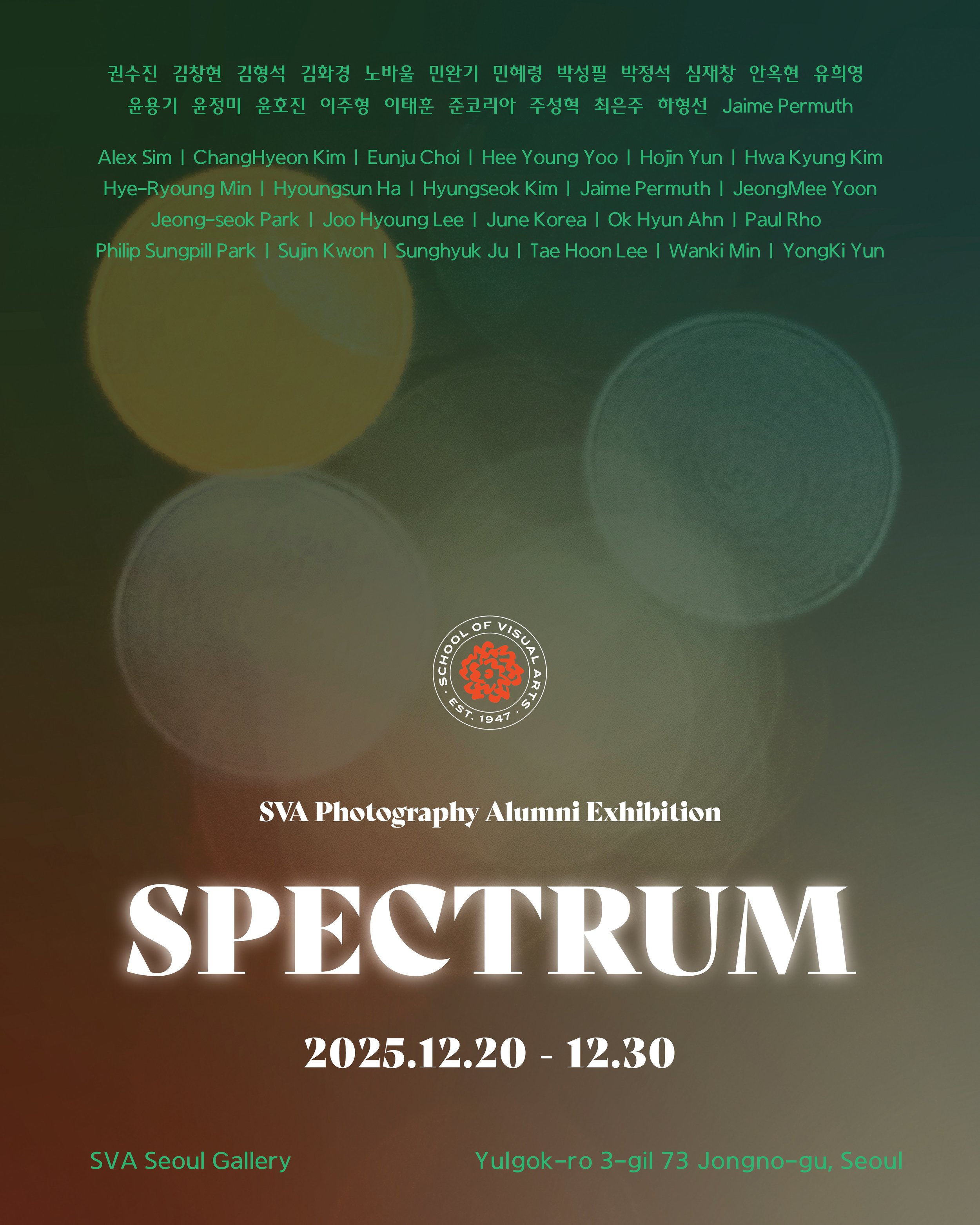
The Seoul Photo Alumni chapter of my Alma Matter SVA is having a group exhibition opening this coming Saturday 12/20 at 5PM.
I am a two-time grad of SVA, first from MFA Photo and Related Media, Class of 1994, and then again from MPS Digital Photography, Class of 2009. I also went on to serve as Faculty of MPS Digital Photography for ten amazing years.
And on a personal note: HRM and I met as students at SVA. We shared wall space for our grad exhibition and it’s so nice to do it again, this time in Seoul.
So looking forward to this!
Spectrum
SVA Seoul Gallery (서울시 종로구 율곡로3길73 (소격동 152)
2025.12.20-12.30
Opening : 12.20(토) 5pm
갤러리 오픈 시간 : 수-일, 오전 10시-오후 6시 (월-화, 공휴일 휴관 (크리스마스 휴관))
Jaewoo and I met a couple years back, when he was selling bicycles at TREK Gwangjin. Eventually he moved onto a new job and then surprised me by attending my Opening Night at iseurrat Artroom, with a gift of a bottle of Wild Turkey under his arm.
A few weeks later, Jaewoo bought himself a Sony camera and started photographing with a deeper intention. Then he switched jobs once again and is now currently selling Hasselblad cameras at a top store in Seoul.
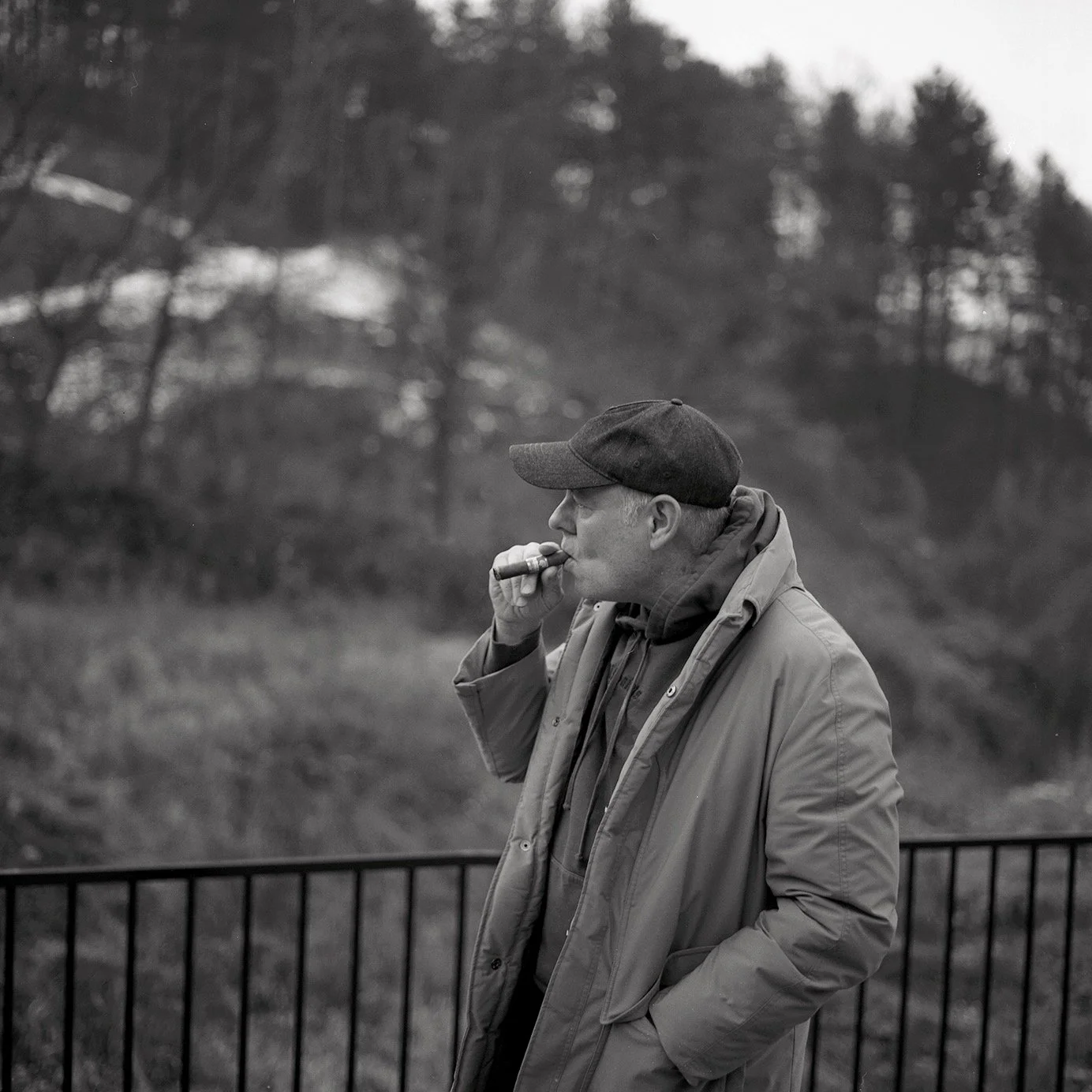
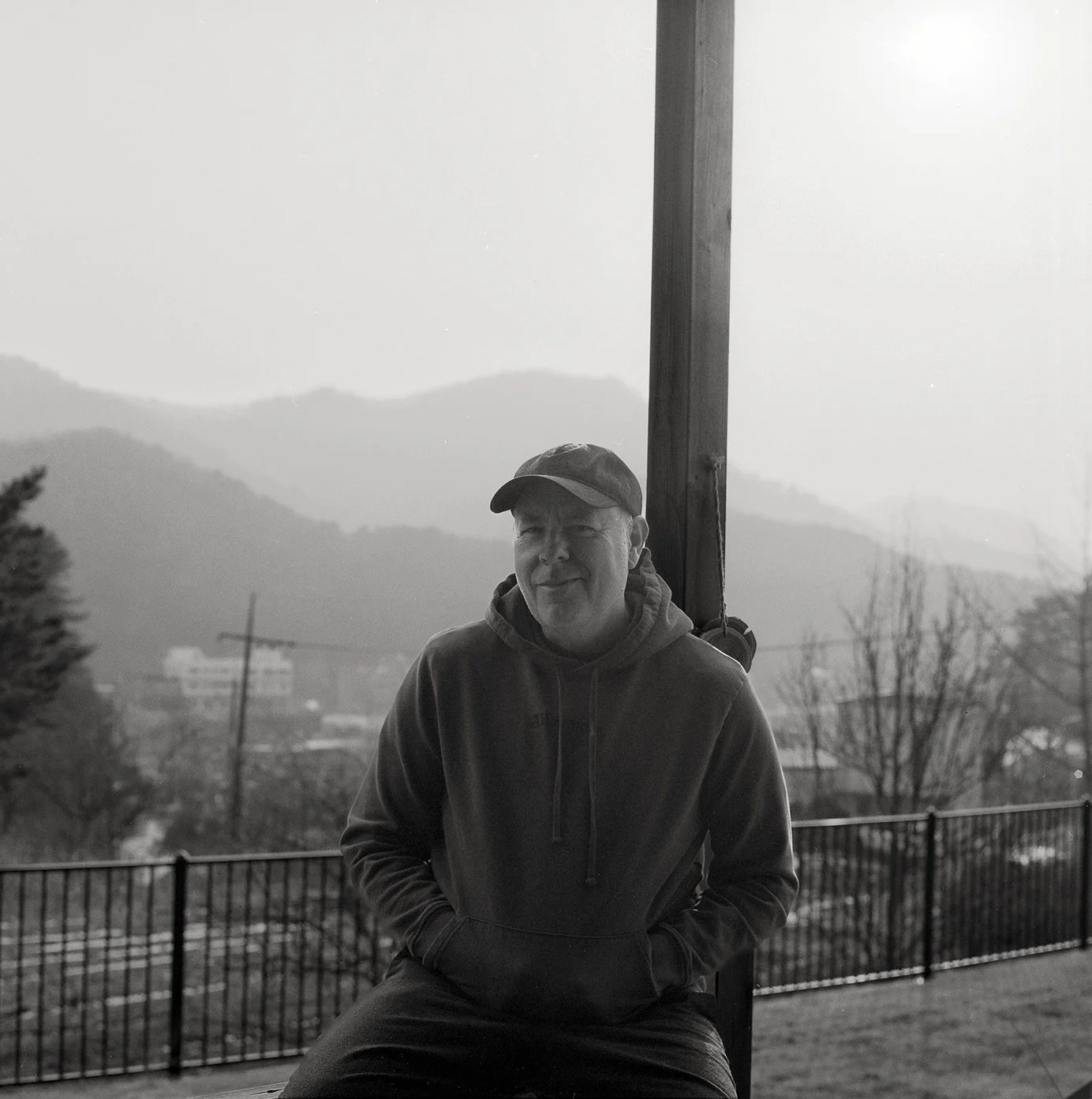
Jaewoo, who is about half my age, came out to visit me at home a couple of weeks ago. He brought along a pair of Cohiba “Lanceros” and we spent a leisurely Sunday afternoon savoring them, drinking bourbon, talking photography and taking a few portraits of each other with a Hasselblad loaded with TMax 100 film.
Unlikely friends? Maybe.
Does that matter?
Not at all ~
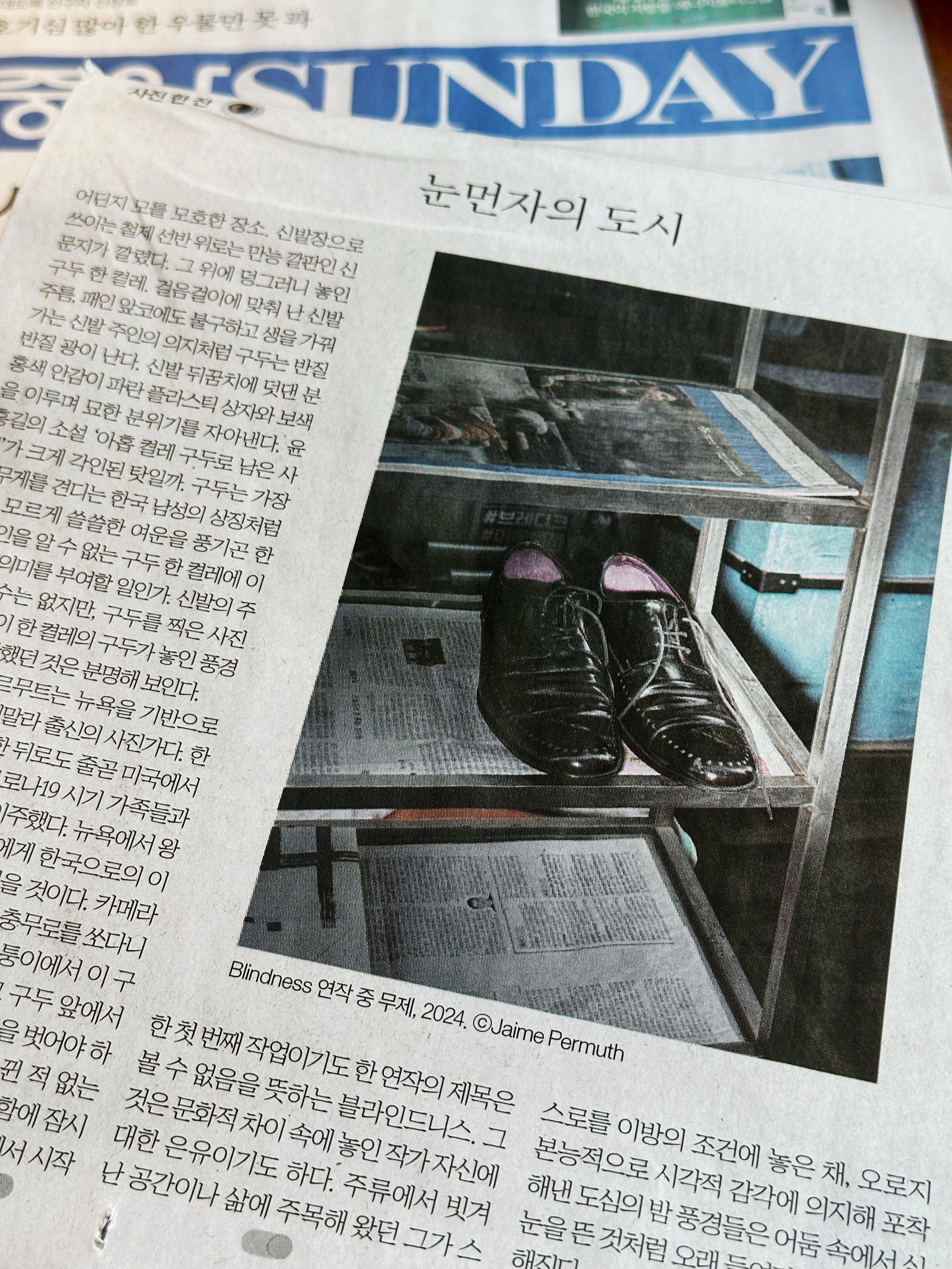
I could not ask for a more thoughtful introduction to myself and my series BLINDNESS, than the one written by Sujong Song, Senior Curator at the National Museum of Modern and Contemporary Art, in today’s edition of JoongAng Sunday.
https://www.joongang.co.kr/article/25386105
“Blind City”
A vaguely defined place whose location is unclear. On top of a metal shelf used as a shoe rack, sheets of newspaper—the universal protective lining—have been spread out. Resting there, all alone, is a pair of dress shoes. Despite the creases formed by the wearer’s gait and the scuffed toes, the shoes shine, polished to a gloss like the determination of their owner, who continues to tend to his life. The pink lining attached to the heels forms a complementary contrast with a blue plastic box, creating a subtle, peculiar atmosphere. Perhaps it’s because of the strong impression left by Yun Heunggil’s novel The Man Who Was Left as Nine Pairs of Shoes. Somehow, dress shoes often carry a faint air of melancholy, like a symbol of Korean men enduring the weight of supporting a family. Is it right to ascribe so much meaning to a single pair of shoes whose owner we cannot even identify? We may not know the owner, but it seems clear that the scene in which the photographer encountered this lone pair of shoes held significance for him.
Jaime Permuth is a Guatemalan-born photographer based in New York. Even after marrying a Korean artist, he continued to live primarily in the United States. During the COVID-19 pandemic, however, he and his family relocated to the outskirts of Seoul. For someone who had been highly active in New York, the move to Korea must have been a new challenge. One night, while wandering with his camera through Jongno, Euljiro, and Chungmuro, he came upon this pair of shoes at the corner of a building along the street. Standing before them, he may have been momentarily captivated by the sense of transience evoked by the cultural practice of removing one’s shoes indoors and the stale newspapers that hadn’t been replaced for a long time. The title of the series—his first body of work begun in Korea— is Blindness, signifying the inability to see. It is also a metaphor for the artist himself, positioned amid cultural differences. Having long focused on spaces and lives that exist outside the mainstream, Permuth placed himself in the condition of a foreigner and relied solely on instinctive visual perception to capture the nighttime urban landscapes. Like opening one’s eyes slowly in the dark, the longer you look, the sharper these scenes become.
— Song Sujong, Senior Curator, National Museum of Modern and Contemporary Art
I wish I had a photograph of that night in Yangpyeong when I was hurtling through the darkness and the beam of my handlebar light picked out the frozen stare of a large deer, standing in the middle of the road, just a few meters ahead.
The encounter was sudden, urgent and fraught with the danger of collision.
It was also utterly and completely different from what the reality of my life in Manhattan ever was.
You can pack a suitcase and go.
But what will life be like on the other side of that leaving?
양평에서의 그날 밤 사진이 있었으면 좋겠어요.
어둠을 가르며 달리던 중, 내 자전거 핸들바 불빛이 도로 한가운데 서 있던 커다란 사슴의 얼어붙은 시선을 비춰냈던 그 순간의 사진을요.
그 만남은 갑작스럽고, 긴박하며, 충돌의 위험으로 가득 차 있었어요.
맨해튼에서의 내 삶의 현실과는 완전히, 철저히 다른 경험이었죠.
당신은 가방을 싸서 떠날 수는 있어요.
하지만 그 떠남 저편에서의 삶은 과연 어떤 모습일까요?
Another aspect of Gwanghapdan that I treasure is that all our members consider writing an extension of their artistic practice. But none of us could ever match Ok Hyun Ahn @ahnokhyun for the soaring flights of her imagination:
“I walked down the hill and climbed up another, a round, low mountain scattered with mounds.
Bodies of this village, long ago, had come to rest beneath the soil.
On the mounds sat young women and men, their faces bright with happiness, their bodies pressed close. An empty can glinted in the sunlight.
A bag of snacks drifted lightly, beautifully, through the air.
I was there, in the middle of that scene.
Desires—cheap and gaudy as fireworks.
Fears—harder to endure than any meaningless outcry.
I saw them, both of them, within me”.
언덕길을 내려와 다시 둥근 낮은 산으로 올랐다.
산 위엔 봉분들이 흩어져 있었다.
오래전 이 마을의 몸들이 흙 속에 잠든 자리였다.
봉분 위에는 앳된 처녀와 총각들이 행복한 얼굴로 몸을 밀착한 채 앉아 있었고, 빈 깡통은 햇빛 속에서 반짝였다.
과자 봉지는 가볍게, 아름답게 공기 위를 떠돌았다.
그 풍경 한가운데 내가 있었다.
싸구려 폭죽보다 더 경박했던 욕망들, 알아들을 수 없는 악다구니보다 더 참기 어려운 두려움, 그것들이 내 안에 있음을 나는 보았다.
Earlier this year, Gwanghapdan gave a talk for Raffaella Gallo’s ARTCaffè. Among other things, we discussed what it means to be a collective of artists. Goseong, made a joke about how people associate the idea of collectives more with 20-year-old students than mid-career artists. And yes, I believe some people are indeed surprised that we are veteran artists who have decided to band together to spend time collaborating and exploring aesthetics.
I am the only non-Korean member of the collective. And one of the things I love about Gwanghapdan is that all members have spent a significant portion of their lives abroad. There is a strong sense of wanderlust running through our veins.
Jiwon Kim spent years based in Germany and some of her remarkably beautiful early work was made in Europe.
Here is Jiwon @jiwon_kim_artist in her own words:
“I am quite used to speaking in an adopted tongue, all to find the perfect vessel for the story I need to tell. This is a subtle knack I picked up while struggling with a second or third tongue: when the inflection and rhythm feel right, people tend to perceive it as genuine fluency. I suspect I have evaded the rigorous demands of true fluency, a quality easily lost in the chase for diverse mediums, by instead offering a compelling rhythm. If I am to hold onto any core attitudes in my work, they must be the three liberties: the liberty to embrace the difficult choice, the liberty of the curving, longer road, and the liberty to reveal where I am unfinished”.
“다루고자 하는 이야기에 적합한 방식을 찾느라 때로는 익숙하지 않은 언어를 구사하는 데에 꽤 익숙하다. 제2, 제3 외국어를 학습하면서 얻은 요령이기도 한데, 억양이 어색하지 않으면 사람들은 유창하다고 인식하기 마련이다. 어쩌면 나는 다채로운 매체를 추구하느라 놓치기 쉬운 유창함을 그럴싸한 억양으로 면해왔겠다. 작업을 해나가면서 굳이 지키고 싶은 태도가 있다면 어려운 것을 택하는 여유, 둘러 가는 여유, 그리고 빈틈을 보여주는 여유일 것이다”.
At Gwanghapdan we will always remember 2025 as the year our Min Gyu @m.g.shin became Jang Sahn. What a journey that has been.
In his own words:
“I am where I do not know”.
“알 수 없는 그 자리에 서 있는”.
Our Gwanghapdan art collective recently held a retreat to gather and enjoy each other’s company; to look back at 2025 and what it meant to us; and to think about our goals and strategies for 2026.
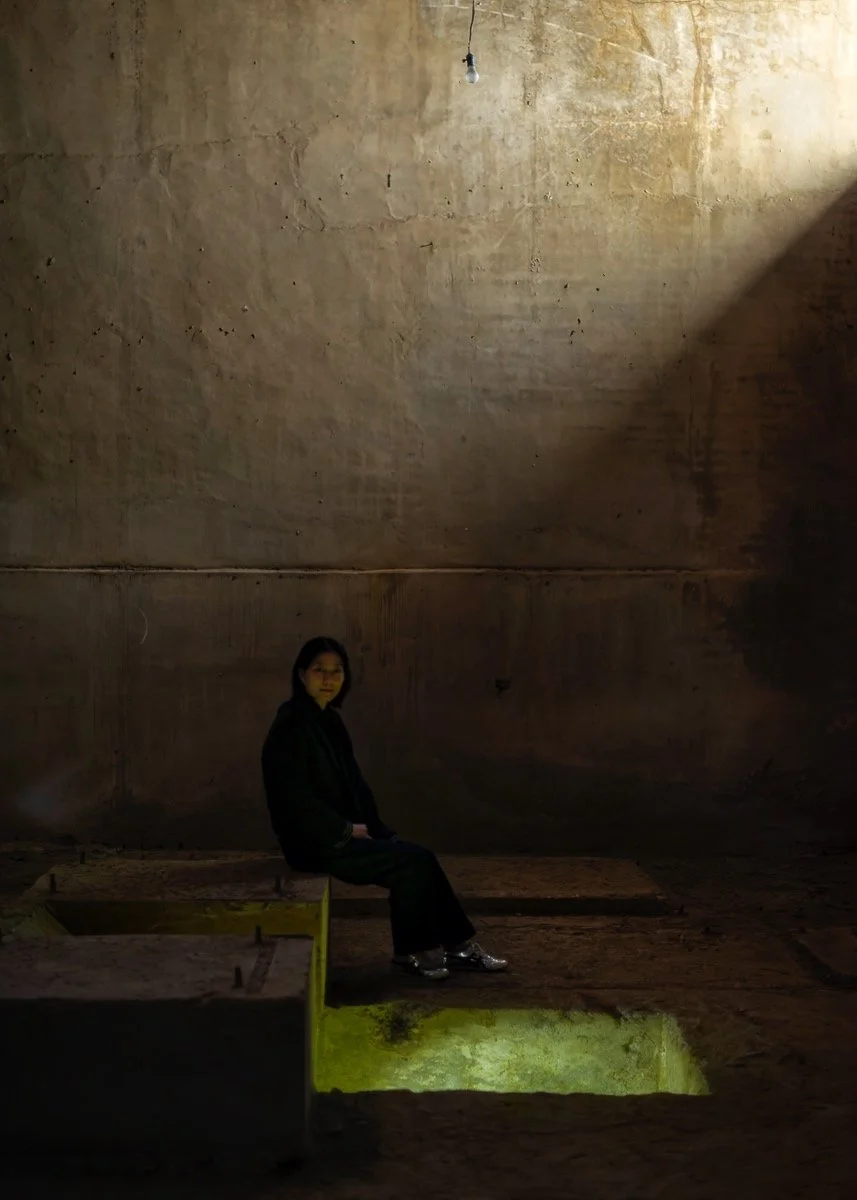
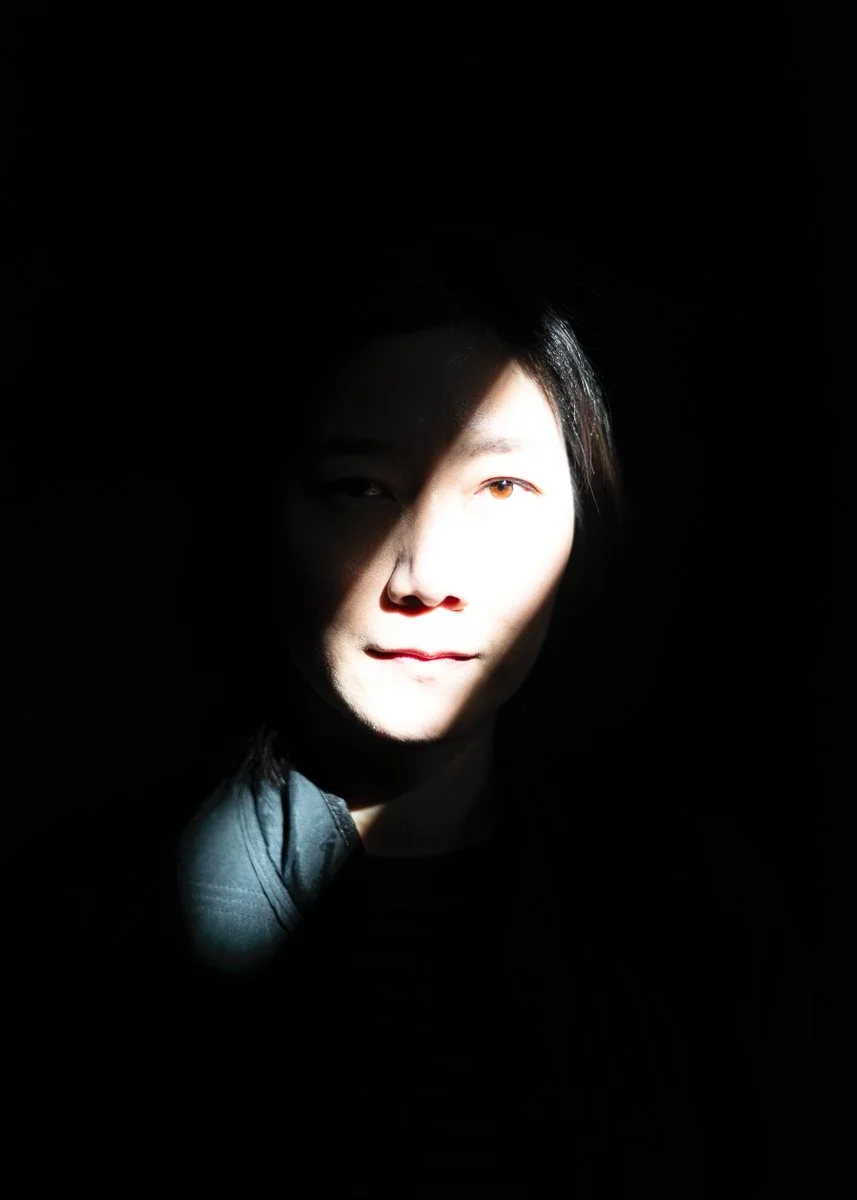
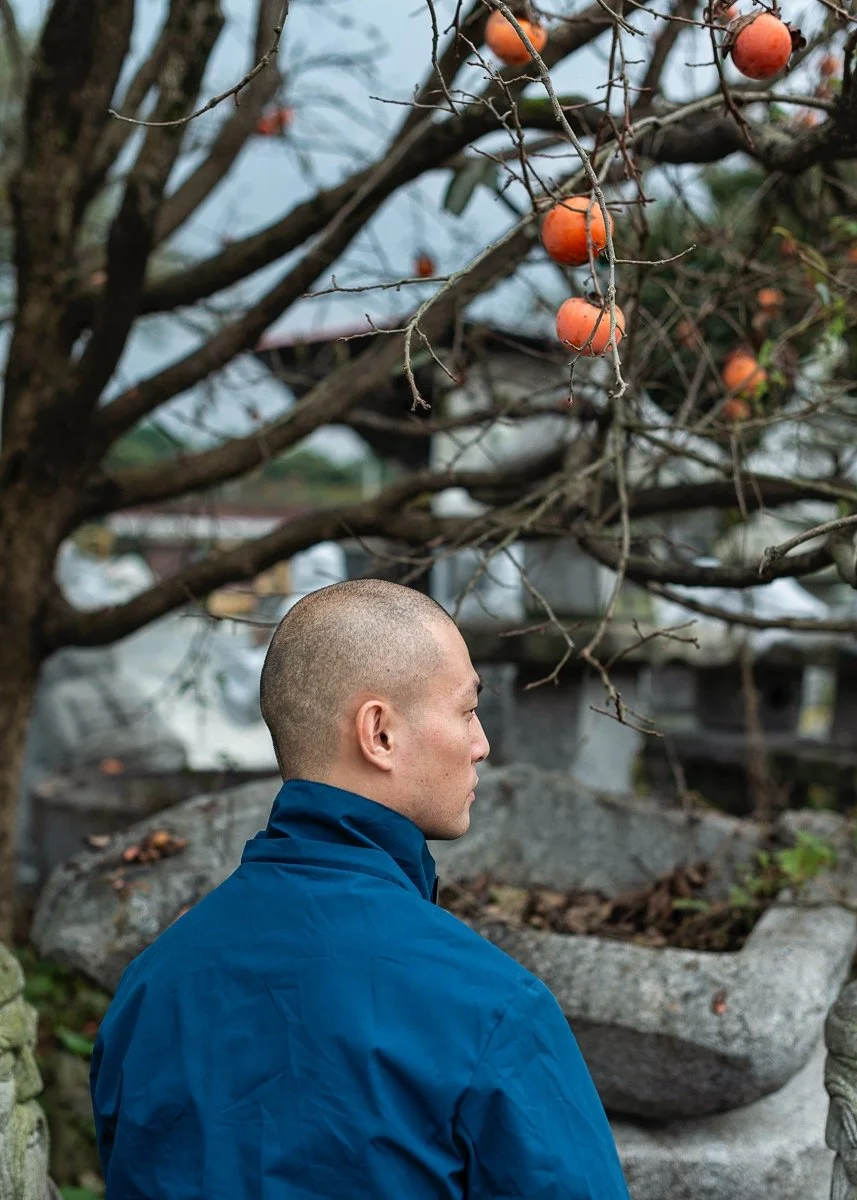
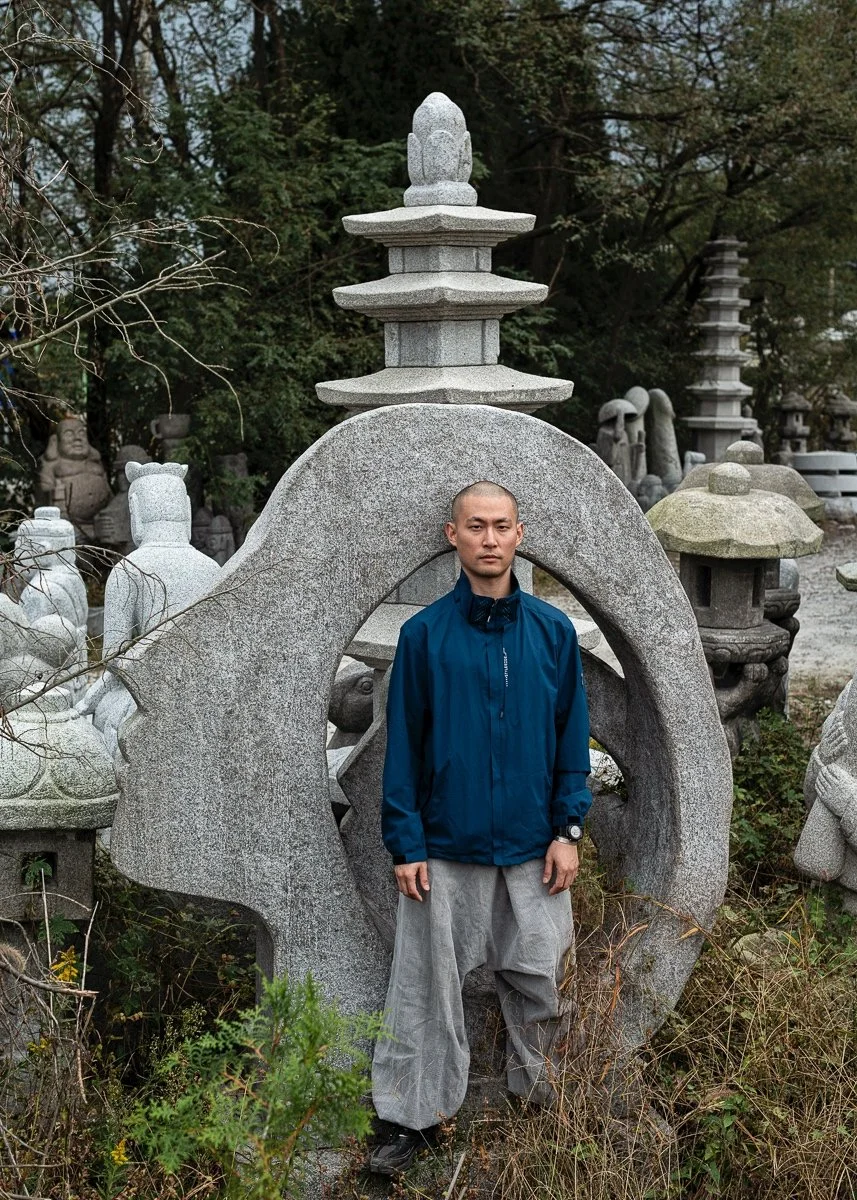
Personally, I decided the retreat would also give me a rare opportunity to make portraits of all of our members.
I’ll be sharing some of those in the coming days,
along with a quote from each artist.
Here’s Goseong:
“When you try to see, you see; when you try to hear, you hear. Upon arriving at this knowing, a languid ambiguity—no longer certain why you seek to see or for what reason you try to hear—reveals and resounds even more. The premonition that you may never fully know emboldens this truth to emerge. The faint hope that the procession of events brings—that is, I come to gather the light of the openings kindled by not-knowing. I come to inhale and exhale those time lags of knowing through which someone’s longing, the origin of someone’s desire, has passed”.
“자 모두 이리 모여 보아요. 준비가 되면 더는 준비가 없는 연속의 오롯한 정경 속으로. 우리가 몸이기 이전의 기억 속으로.”
“하나, 둘, 둘 다음엔 뭐였더라, 아득히.”
보려고 하면 보이고, 들으려 하면 들립니다. 여기까지 알게 되었을 때, 왜 보려 하고 어째서 들으려는지 모르겠는 나른한 막연함이 이것을 더 보여주고 들려줍니다. 영영 알 수 없으리란 예감이 이 사실을 드러내도록 용기를 줍니다. 사건의 나열이 가져다주는 어렴풋한 희망, 그러니까 모름으로 열리는 틈새 틈새마다의 빛을 담습니다. 누군가의 염원, 누군가의 바람의 기원이 통과해 온, 그 시차들을 들이쉬고 내쉽니다.”
A few days on the road with the boys.
Today we arrived in Taean ~
Olin and Luca. Still just kids. Happy to chase insects all day and improvise make shift cages out of any old thing that is at hand. But occasionally, when I look into their faces, I get a glimpse of the men they will become some day. And I feel a rush of pride.
Next week they turn seven!
On the last day of Seoul Publishers Table, I had a chance to meet poet Son Junsu. We were standing in line to order coffee and struck up a conversation.
Later on, back at the book fair, I found him seated at his table behind a vintage typewriter. I asked him to compose a short poem for HRM, whom he had yet to meet. He asked me to provide him three words that he could use as prompts. I mentioned her “soft puffy eyelids” (there’s a special expression for that in Korean: 눈 두 덩이); “New York” and finally “In-between”.
Oddly enough, I felt like I was asking Chat GPT to write a poem for me. But then Junsu paused for a beat, fed a single sheet of hand-made paper through the carrier and started typing the lines of his poem, smoothly and with effortless grace. And the poem itself is ever so disarmingly simple, so charming and tender.
What a gift and what a highlight from the book fair.
And our Gwanghapdan table sold out of just about everything we had 🍻
See you next year!